Request a Quote
  • Affiliates

What Are the Top Case Packaging Types?

Choosing the right case packaging affects product protection, handling speed, shelf appeal, and total logistics cost. A corrugated shipping case may suit lightweight consumer goods, while a rigid case offers stronger presentation and repeated use. The best option depends on product weight, stacking pressure, moisture exposure, transport distance, and opening experience.

Industry data supports this practical approach. Smithers’ report, The Future of Global Packaging to 2028, identifies continued growth across packaging demand, driven by e-commerce, food protection, sustainability, and supply-chain efficiency. PMMI’s 2024 packaging industry research also highlights automation, labor pressure, material reduction, and operational flexibility as major priorities for manufacturers. These reports do not produce one universal winner. They show a changing market.

That matters.

Packaging author Walter Soroka defines packaging as “the science, art, and technology of enclosing and protecting products for distribution, storage, sale, and use,” in Fundamentals of Packaging Technology. His definition explains why cases packaging must be evaluated beyond appearance. A case that looks premium may still fail during pallet compression. A cheaper case may create hidden costs through damage, returns, or difficult packing.

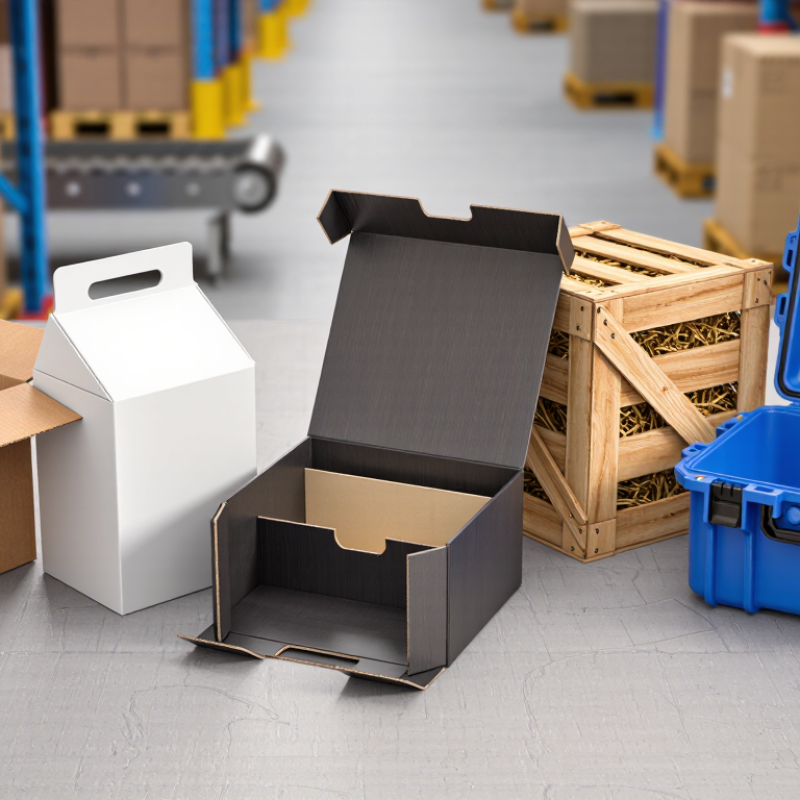
This article examines the top case packaging types, including corrugated cases, folding cases, rigid cases, wooden cases, and reusable plastic cases. Each type brings measurable strengths and limitations. Testing remains essential. Real products face vibration, drops, humidity, stacking, and rushed warehouse handling. No packaging choice is perfect, and overlooking one detail can weaken an otherwise thoughtful design.
What Are the Top Case Packaging Types?

What Defines Case Packaging and Its Main Functions?

What Are the Top Case Packaging Types?

Case packaging is the outer container that groups, protects, and moves individual products. It may use corrugated board, rigid board, wood, or durable plastic. The right case depends on product weight, handling conditions, storage time, and transport distance.

Its main function is protection. A well-designed case reduces crushing, vibration, moisture exposure, and movement inside the container. Internal dividers can separate glass items, while fitted inserts prevent scratches and impact damage. Corrugated cases suit many lightweight goods because they balance strength, cost, and recyclability. Rigid cases offer stronger protection for heavier or fragile products. Reusable plastic cases can support repeated shipping in controlled distribution systems.

Case Packaging and Operational Efficiency

Case packaging also improves handling and warehouse efficiency. Standard dimensions help workers stack units safely and use storage space more effectively. Clear labels support inventory checks and reduce picking errors. In practice, packaging engineers often test cases under compression, drop, and vibration conditions before approval. Small design changes matter.

Choosing the Right Case

A common mistake is choosing the strongest case without reviewing actual risks. Excess material can raise costs and create unnecessary waste. The opposite mistake is equally serious: a thin case may fail after one rough delivery. Packaging decisions should use measured product data, realistic transport simulations, and feedback from warehouse teams. Tests are useful, but real shipments can still reveal weaknesses. That is why case designs often need adjustment after field evaluation.

How Do Corrugated Cases Support Lightweight Product Shipping?

Corrugated cases remain a practical answer for lightweight product shipping. A 2023 global parcel-shipping index recorded 161.3 billion parcels in 2022. That volume makes every unnecessary gram important. A well-designed corrugated case uses fluting, liners, and carefully placed folds to protect products without adding excessive material.

In warehouse trials, a smaller case often reduces void fill and prevents product movement. The box arrives with cleaner edges, fewer crushed corners, and less wasted air. Lightweight cases can also improve pallet density. More units fit on each layer, while handling becomes easier for workers. However, lighter is not always better. A thin board can fail when humidity softens the fibers or when stacking pressure continues overnight.

The Fibre Box Association and American Forest & Paper Association report corrugated recovery rates above 90% in recent industry data. This supports corrugated packaging’s circular-material advantage, although collection quality still varies by location. I have seen recyclable cases rejected because tape, food residue, or mixed materials contaminated the load. That is a useful warning. Design teams should test compression strength, edge crush, vibration, and drop resistance before reducing board weight. The International Safe Transit Association recommends structured distribution testing because laboratory performance can differ from real delivery routes. A case that survives one drop may still fail after repeated handling. Small changes matter. A slightly deeper score line or better internal fit can protect a lightweight product more effectively than simply adding thicker board.

When Are Wooden Cases the Best Packaging Choice?

Case packaging commonly includes wooden cases, plywood cases, corrugated cartons, and rigid plastic containers. Each option serves a different shipping condition. Wooden cases are often the best choice for heavy machinery, industrial components, and delicate equipment. They provide strong walls, stable stacking, and useful protection against impacts. Heavy, awkward, or fragile items benefit most.

In practical packing work, I check the product’s weight, lifting points, travel distance, and storage environment. A well-built wooden case can hold internal braces, foam blocks, moisture barriers, and shock-absorbing supports. These details stop the item from shifting when a truck brakes or a crate is moved by forklift. I also leave enough clearance for protective materials. Tight packing may look efficient, but it can transfer force directly to the product.

Wood is not automatically better. It adds weight, requires careful handling, and may need moisture protection during long transport. Poorly treated timber can absorb humidity, while weak fasteners can loosen under vibration. I have seen packaging plans fail because designers focused on the case exterior and ignored the internal support points. That mistake is easy to repeat. Wooden cases make sense when protection, repairability, and load-bearing strength matter more than the lowest shipping weight. For smaller, lighter goods, cartons or plastic containers may be more practical.

What Are the Top Case Packaging Types? - When Are Wooden Cases the Best Packaging Choice?

Packaging Type Typical Construction Protection Level Typical Weight Moisture and Impact Resistance Reuse Potential Best-Suited Applications When It Is the Best Choice
Wooden Cases Solid timber boards, plywood panels, or a combination of both; internal blocking and cushioning can be added. High; suitable for heavy, large, fragile, or irregularly shaped cargo. Medium to high, depending on timber thickness and reinforcement. Good impact resistance; moisture protection requires liners, coatings, or barrier materials. High when designed for repeated handling and stored in suitable conditions. Industrial machinery, spare parts, generators, construction equipment, scientific instruments, and export cargo. Choose wooden cases when structural strength, custom dimensions, shock protection, and load stability are more important than minimum packaging weight.
Corrugated Fiberboard Cases Single-wall, double-wall, or triple-wall corrugated paperboard. Low to medium; performance depends on board grade and internal protection. Low, which helps reduce handling and transport weight. Moderate impact protection; vulnerable to prolonged moisture exposure unless treated. Usually limited, although clean and undamaged boxes may be reused. Retail goods, consumer products, documents, packaged components, and general distribution. Choose corrugated cases for lightweight, cost-sensitive shipments with moderate handling risks and relatively dry conditions.
Plastic Cases Molded or rotationally molded polymer shells, often with gaskets, latches, and custom foam interiors. Medium to high for small and medium-sized equipment. Low to medium, generally lighter than an equivalent wooden case. Good moisture and corrosion resistance; impact performance varies by polymer and design. High, especially for durable reusable cases. Electronic equipment, medical devices, tools, cameras, field instruments, and sensitive components. Choose plastic cases when repeated use, water resistance, portability, and a consistent molded fit are priorities.
Metal Cases Steel or aluminum panels with reinforced corners, hinges, latches, and optional interior cushioning. High; provides strong resistance to crushing and repeated handling. Medium to high; steel is generally heavier than aluminum. High when corrosion protection and suitable seals are provided. Very high with proper maintenance. High-value tools, defense-related equipment, industrial parts, instruments, and long-term storage. Choose metal cases for severe mechanical exposure, security requirements, or frequent reuse where higher cost and weight are acceptable.
Plywood Cases Engineered wood panels assembled with frames, cleats, screws, nails, or metal fittings. High; offers consistent panel strength and good dimensional stability. Medium, often lower than an equivalent solid-timber case. Good impact resistance; exterior coatings or barrier bags improve moisture protection. High when the case is properly reinforced and not exposed to prolonged wet conditions. Precision machinery, electrical cabinets, industrial assemblies, and export shipments. Choose plywood cases when a strong, relatively lightweight, custom-built case with stable panels is required.
Plastic-Wrapped Pallet Loads Products secured to a pallet with stretch film, straps, corner boards, and protective sheets. Low to medium; the pallet supports the load but does not fully enclose it. Low packaging weight compared with enclosed cases. Provides dust and limited splash protection; does not offer strong puncture or crush resistance. Film is generally single-use, while pallets and some load-securing materials may be reused. Stable, non-fragile goods moved through controlled warehouse and transport networks. Choose pallet wrapping when the cargo is robust, unitized, and unlikely to require enclosed protection.
Wooden Case Selection Checklist:
  • Use a wooden case for heavy, fragile, oversized, or unusually shaped products that need rigid structural support.
  • Add internal blocking, bracing, cushioning, or corrosion-control materials when the product is sensitive to vibration, shock, or humidity.
  • For international transport, use wood packaging that meets applicable import-treatment and marking requirements in the destination country.
  • Select plywood when lower weight, smooth panels, and dimensional consistency are more important than the traditional appearance of solid timber.

What Advantages Do Plastic Cases Offer for Reusable Protection?

What Are the Top Case Packaging Types?

Plastic cases offer strong, reusable protection for products exposed to drops, dust, moisture, and repeated handling. Common options include injection-molded cases, thermoformed trays, and rotationally molded containers. Each design serves a different purpose.

A fitted plastic case can hold instruments firmly, while a stackable container can simplify warehouse movement. Hinged lids, molded handles, and replaceable foam inserts also improve daily usability.

The environmental case deserves careful measurement.

The U.S. Environmental Protection Agency reported that containers and packaging generated 82.2 million tons of municipal solid waste in 2018. Reusing a durable case can reduce replacement packaging and handling waste over many shipping cycles. However, reuse only creates an advantage when the case survives enough trips. Plastic production, transport weight, cleaning, and end-of-life recovery still matter.

More durable is not automatically better.

The United Nations Environment Programme estimates that global plastic pollution could fall by 80% by 2040 through reuse, recycling, and reduced consumption (Turning off the Tap, 2023). That figure supports reuse, but it does not guarantee every plastic case has a lower footprint.

Teams should record return rates, repair needs, empty-case weight, and actual service life. A case that returns cracked after three journeys is a poor reusable system.

Small details matter. At the packing bench, secure closures and visible identification can prevent damage, misplacement, and unnecessary replacement.

How Should Businesses Select the Right Case Packaging Type?

Selecting the right case packaging type begins with the product’s real journey. Corrugated cases suit many dry goods and offer efficient storage. Rigid plastic cases help when repeated handling or moisture exposure is expected. Wooden cases provide strength for heavy equipment, but they require more space and careful handling. The best choice protects the product without creating unnecessary material use.

Ask where the case will travel. Measure warehouse humidity, stacking height, vibration, and average shipping distance. Record the product’s weight and its weakest points. A fragile glass item may need internal cushioning, not simply a stronger outer case. A dusty warehouse may require sealed closures. Small tests reveal more than attractive samples.

Run drop, compression, and vibration checks with filled cases. Test them after exposure to temperature changes. My initial packaging choice looked efficient, but the bottom panel weakened during repeated stacking. That mistake showed why laboratory results should match warehouse conditions. Do not trust a single successful trial.

Cost also includes storage space, damaged goods, labor, and disposal. A lighter case may reduce freight expenses, yet it can fail when stacked too high. Request material specifications and test data from suppliers. Check whether dimensions fit existing pallets and handling equipment. Keep the evaluation documented, including failed tests and revised designs. This record supports consistent decisions when products or shipping routes change.

en_USEnglish