China’s fiber molded packaging industry is moving from a niche solution toward mainstream protective packaging. Smithers’ “The Future of Molded Fiber Packaging to 2028” reports continued market growth, driven by plastic reduction, food-service demand, and retailer sustainability targets. Exact forecasts vary between research firms. That difference deserves attention.
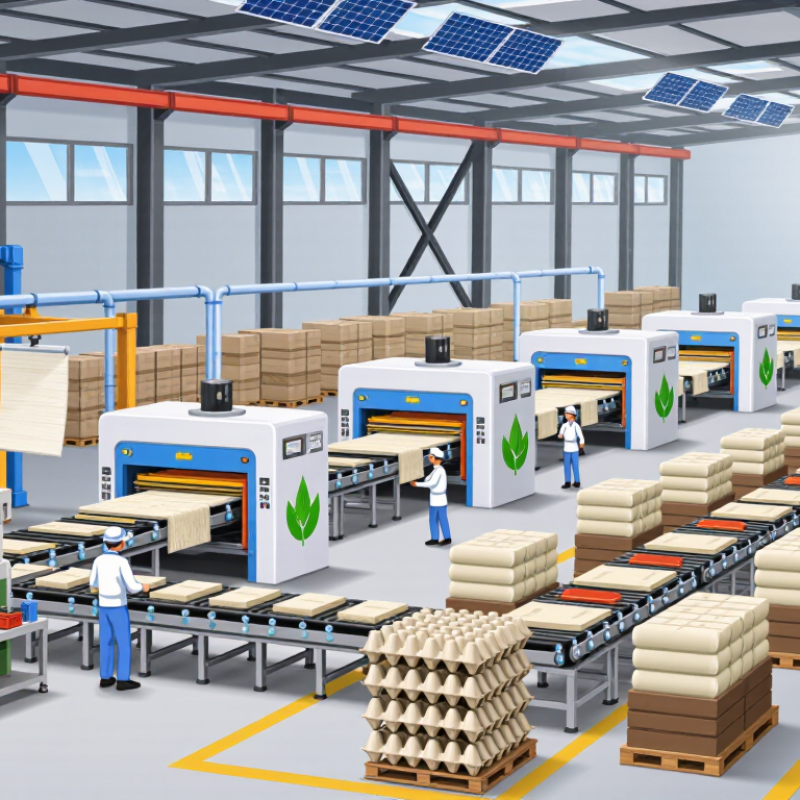
Molded pulp trays now protect eggs, electronics, cosmetics, and takeaway meals. At a modern Chinese production line, recycled paper is pulped, refined, formed, pressed, and dried into a rigid tray. Small details matter. Moisture resistance, edge strength, surface finish, and nesting efficiency can decide whether a package survives shipping. IMARC Group also identifies rising e-commerce and sustainable food packaging as major growth drivers.
The Ellen MacArthur Foundation states, “We need to rethink the way we make and use products.” Her circular-economy perspective applies directly to fiber molded packaging. However, fiber is not automatically sustainable. Energy consumption, water use, coatings, transport distance, and recycling conditions must be measured together. A lightweight tray can still perform poorly if it travels across several continents.
China offers strong manufacturing depth, automated tooling, competitive production costs, and expanding material research. Yet a reliable manufacturer should provide more than attractive samples. Buyers need compression-test results, food-contact documentation where applicable, moisture testing, dimensional tolerances, and traceable recycled-fiber information. Certifications help, but they do not replace practical verification.
This article examines how to evaluate China’s best fiber molded packaging manufacturers. The comparison will consider engineering capability, production consistency, customization, quality control, and environmental evidence. Some claims will remain imperfect. Real packaging decisions rarely fit a simple “green” label.
China’s fiber molded packaging sector expanded throughout 2024. Public data from the China Packaging Federation indicates continued growth in paper-based protective packaging. Industry estimates place China’s molded fiber output near two million tonnes in 2024. The figure varies by product definition. That limitation matters.
China Customs trade records for molded paper and pulp articles show strong overseas demand. Export activity remained concentrated in food trays, beverage carriers, egg packaging, and protective inserts. Several market analyses, including Smithers’ molded fiber packaging research, identify China as a major production and conversion base. Lower labor costs help, but automation now matters more.
Leading manufacturers typically operate multiple forming lines. Their annual capacity often ranges from 10,000 to 50,000 tonnes. Larger facilities may exceed that range after expansion. Reliable suppliers should provide audited output, export volume, machine utilization, and monthly capacity data. A factory’s installed capacity is not its real production. This is an easy mistake.
Practical experience also shows quality depends on tooling control. Uneven drying can create warped edges and weak corners. Advanced plants monitor moisture, wall thickness, compression strength, and production waste. Export-ready factories also maintain documented testing procedures for food-contact applications. Independent verification remains necessary. Numbers alone cannot prove manufacturing excellence.
China Best Fiber Molded Packaging Manufacturer
Materials and Processes: 4 Feedstocks, 3 Molding Methods, 1 Production Flow
Fiber molded packaging begins with the right feedstock. Recycled paper offers stable fiber length and predictable pulping behavior. Bagasse brings a smooth surface and supports agricultural waste reduction. Bamboo provides strong fibers, but it needs careful refining. Wheat straw can lower material costs, although seasonal variation may affect consistency. Each material requires different water levels, refining time, and drying control.
Three molding methods cover most practical applications. Wet pressing creates dense trays with clean edges and strong dimensional accuracy. Dry forming uses less water and works well for protective inserts and irregular shapes. Thermoforming improves surface detail and produces a more refined appearance. However, sharp corners can still create weak spots. That issue deserves more testing.
One production flow connects the work. Fibers are sorted, pulped, refined, mixed, formed, dewatered, pressed, dried, trimmed, and inspected. Operators check wall thickness, moisture, edge strength, and fit against the product. Small changes matter. A slightly uneven mold can leave thin areas after pressing. In daily production, practical experience often reveals problems before laboratory data does. Reliable manufacturing therefore depends on documented settings, trained inspection teams, and honest review of failed samples.
Fiber molded packaging commonly uses recycled paper fiber, virgin wood fiber, bagasse, and bamboo fiber as feedstocks. The main forming routes are wet forming, dry forming, and thermoforming or hot-press molding, followed by one integrated production flow from material preparation to finished-pack inspection.
The chart summarizes the four feedstock categories, three primary molding methods, and one unified production flow described in the topic.
Fiber molded packaging begins with a practical wall thickness decision. Our engineering work typically evaluates sections from 1.5 to 5 mm. Thin walls reduce material use, but they demand accurate pulp forming and controlled drying. Thicker walls improve stiffness around heavy products, yet they may increase weight and restrict nesting efficiency. Small details matter. Corner radii, ribs, vents, and product clearance can change performance significantly.
We use 3D product data to develop protective cavities, then review draft angles and demolding risks. Samples are checked for warping, sharp edges, compression loss, and fit consistency. Moisture also deserves attention. A dry warehouse sample may behave differently after humid storage or transport. That result can be inconvenient, but ignoring it creates false confidence.
ISTA 3A testing helps examine packaged products under parcel distribution conditions. Test plans may include vibration, repeated drops, compression, and handling sequences. We inspect the product after each stage, not only at the end. Scuffing, cracked corners, shifted inserts, and hidden deformation are recorded with photographs and measurements. A passing laboratory test does not guarantee every route will be gentle. Packaging design still needs field feedback, production checks, and periodic retesting. Sometimes the first design passes structurally but feels difficult to pack. That is not failure; it shows where engineering must improve.
Fiber molded packaging must prove more than a natural appearance. ISO 18606 evaluates packaging designed for organic recycling, including biodegradation, disintegration, and material safety. EN 13432 sets related requirements for industrial compostability, but certification does not guarantee home composting. Processing conditions matter.
In production, we inspect recycled fiber for moisture, ink residue, plastic fragments, and unstable strength. These details affect molding, drying, and final protection. Clean post-consumer fiber can reduce virgin material use, yet it may create inconsistent color or surface texture. That is not always a defect. It can show recycled content honestly. We still need better sorting.
Tips: Request test reports, fiber-source records, and clear disposal instructions. Check whether local facilities accept certified compostable packaging. Ask for performance testing under humid storage and stacked transport. Small gaps in documentation can become large compliance problems.
A reliable manufacturer should connect laboratory evidence with factory experience. Sample trays may pass compression tests but fail after repeated humidity exposure. We have seen this happen.
Product design should match its actual journey, not only its sales image. Specifications should state recycled fiber percentages, coatings, additives, and intended recycling routes. Some projects need revision after testing. That is responsible development, not failure.
Selecting a fiber molded packaging supplier requires evidence, not attractive samples. Smithers’ 2024 market outlook identifies sustainability and supply reliability as major packaging purchasing drivers. Ask for the minimum order quantity, not only the quoted unit price. A low MOQ may reduce inventory risk, while high-volume orders can lower tooling and freight costs. Confirm whether the mold is dedicated, shared, or refundable.
Tooling lead time should include design approval, CNC production, trial molding, and corrections. In practice, 25–45 days is a realistic planning range for many molded fiber projects. Confirm every stage in writing. Quality control needs measurable limits. Use ISO 2859-1 sampling plans for visual defects, dimensional checks, and functional tests. ASTM D4169-style distribution testing can reveal crushed corners before shipment. Small cracks matter.
A factory audit should score five metrics: on-time delivery rate, first-pass yield, defect parts per million, corrective-action closure time, and traceability coverage. Request at least twelve months of records. Check whether batch codes reach pulp preparation, forming, drying, and packing. Ask to see moisture testing beside the production line. A 2023 packaging sustainability survey by McKinsey reported that consumers continue to value recyclability, but supplier data often remains inconsistent. That gap deserves attention. I would also test three recent batches, not one perfect sample. One audit cannot prove stable performance.