
Street lighting shapes how people see a road, sidewalk, and nearby entrance after dark. A suitable Street Outdoor Light can improve visibility while fitting the character and practical needs of its location. But “street light” covers several fixture types, and they do not serve identical purposes.
This guide introduces common options, including cobra-head roadway lights, decorative post-top lamps, wall-mounted fixtures, bollard lights, solar models, and LED area lights. Each has different strengths. A cobra-head fixture may suit a broad road, while a bollard can mark a pedestrian path without dominating it. Small details matter: mounting height, pole spacing, light direction, glare, maintenance access, and the color of nearby surfaces can all affect the result. Consider a wet sidewalk or a tree-lined corner; the same lamp may feel quite different in each setting.
There is no universal best choice. Product names can also be confusing, so compare the fixture’s distribution pattern and intended use, not just its appearance. For larger projects, a qualified lighting professional can review photometric plans and applicable local requirements. For a small property, clear information about installation and upkeep is still useful. A practical comparison has limits. Real streets vary, and that matters. The sections ahead explain the main types, where they tend to work, and what to check before choosing one.
Street outdoor lights are commonly classified by the technology that produces their light. Today, light-emitting diodes, or LEDs, are widely used because they use energy efficiently and can direct light onto roads and sidewalks. Their color temperature and brightness can be selected for different streets. A well-designed fixture also limits glare, though poor placement can still send light toward nearby windows.
High-pressure sodium lamps create a familiar amber glow. They have served many roads reliably, but their limited color rendering can make details harder to distinguish. Metal-halide lamps produce a whiter light and reveal colors more clearly. However, they may require more maintenance and can take time to reach full brightness after switching on. Small details matter.
Some older installations use low-pressure sodium lamps, which produce a distinctly yellow light and show colors poorly. Their simple, efficient output can suit specific needs, but it is less flexible for mixed-use streets. These categories describe the lamp, not its power supply: solar-powered street lights, for example, may still use LEDs. There is no perfect source. Local weather, mounting height, road activity, and maintenance access all affect performance, and a specification sheet cannot tell the whole story.
Indicative luminous efficacy ranges for common street-light sources (lumens per watt).
LEDs are widely used for new street-lighting projects because of their efficiency and long service life. Sodium and metal-halide lamps remain familiar technologies; actual efficacy varies by lamp, wattage, and equipment.
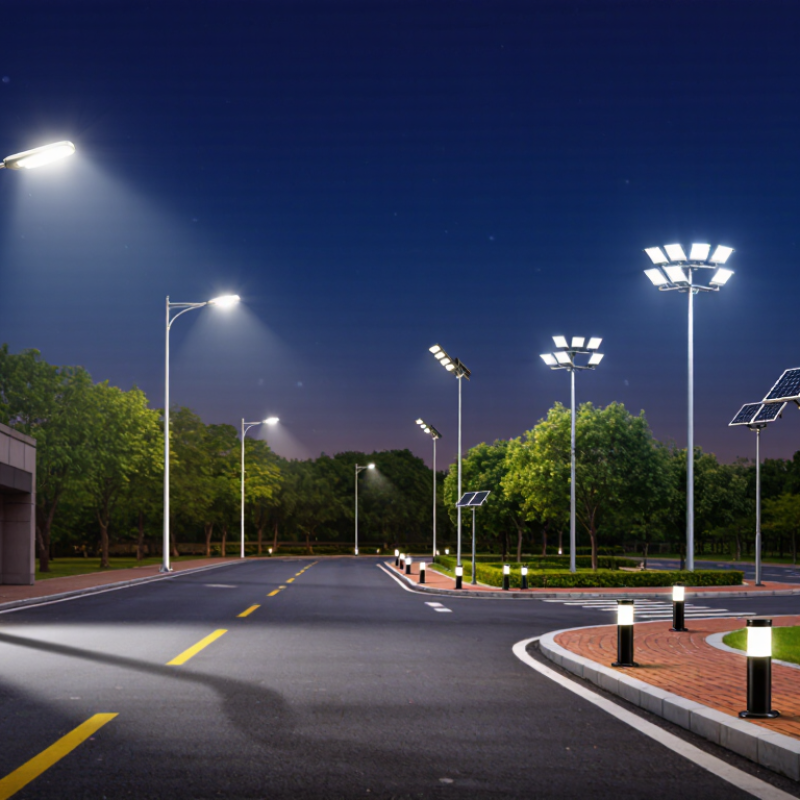
Street-light fixtures are chosen by road geometry, mounting height, and the direction light must travel. The familiar cobrahead luminaire suits many roadways because its forward-throw optics can illuminate lanes from a side-mounted pole. Post-top fixtures spread light around plazas and residential streets, while shoebox-style area lights often serve broad intersections and parking areas. High-mast luminaires cover large junctions, but their height can make maintenance more demanding. Decorative lanterns add character, though appearance alone cannot ensure safe, even illumination.
Look beyond the housing. IES RP-8-18 bases roadway lighting recommendations on road and pedestrian conditions, not fixture shape alone. Its guidance makes uniformity and glare important design considerations. The U.S. Department of Energy’s Energy Saver guidance reports that LEDs use up to 90% less energy than incandescent lamps and can last up to 25 times longer; that comparison is not a direct measure against older street-light technologies. A fixture’s real savings depend on its optics, controls, and operating schedule. A neat catalogue can mislead. Check the photometric plan: does light reach the pavement, or spill into bedroom windows? The answer may favor a plain roadway head over a more decorative option.
Local streets need shielded luminaires with modest output and good sidewalk coverage, keeping light off bedroom windows. Not just brighter. FHWA’s Lighting Handbook links lighting design to road function, speed, pedestrian activity, and local conditions, not wattage alone.
At intersections and bus corridors, broader distributions can reveal turning vehicles, waiting passengers, and curb edges. NHTSA’s 2022 Traffic Safety Facts reports that 77% of pedestrian fatalities occurred in dark conditions. That figure signals a visibility concern, not proof that lighting alone prevents crashes.
Highways may need higher mounting and roadway-specific photometry for even coverage. Parks and plazas often suit lower poles, controlled spill, and comfortable light. The U.S. Department of Energy’s 2017 forecast projected 569 terawatt-hours of annual savings in 2035 under widespread LED adoption. The estimate covers general lighting, not streetlights alone; optical design still determines where light lands. Even careful plans can leave a dim patch beside a tree.
Solar and grid-powered street lights can use the same efficient LED fixtures; their key difference is where electricity comes from. Solar units collect sunlight through a panel and store energy in a battery, so they can suit remote roads where trenching cables is costly. Their performance depends on panel placement, shade, weather, and battery condition. A row of trees can quietly reduce charging.
The U.S. Department of Energy’s 2016 report, LED Street Lighting and Utility Programs, describes energy savings of about 50% or more when LED streetlights replace conventional systems. That saving applies to the lighting technology, not automatically to solar power. Grid-connected lights draw steady power and are easier to keep running through long, cloudy periods, but installation may require wiring and excavation. Solar avoids that connection, yet battery replacement and winter charging need careful budgeting. Neither option is best everywhere.
Tips: Check local winter sunlight, nighttime operating hours, and backup needs before choosing solar. For grid projects, compare trenching costs with long-term electricity bills. Inspect batteries and panels regularly; small maintenance gaps matter.
| Category | Light Type or System | Power Source | Typical Applications | Key Benefits | Main Considerations |
|---|---|---|---|---|---|
| Common Types of Street Outdoor Lights | |||||
| Roadway lighting | LED cobra-head or roadway luminaire | Usually grid-powered; solar versions are also used in suitable locations | Streets, roads, and intersections | Directional optics can distribute light along the roadway and limit unnecessary spill when properly designed. | Pole spacing, mounting height, light distribution, and applicable roadway standards affect performance. |
| Pedestrian-area lighting | LED post-top or area light | Grid-powered or solar-powered | Sidewalks, paths, plazas, and parks | Can provide more localized illumination for pedestrian spaces and public areas. | Optics and placement should reduce glare and avoid poorly lit gaps between fixtures. |
| High-area lighting | High-mast LED lighting | Typically grid-powered | Large intersections, interchanges, and transport areas | A high mounting position can illuminate a broad area from fewer poles. | Installation and maintenance may require specialized equipment and access planning. |
| Decorative streetscape lighting | Decorative post-top or heritage-style LED fixture | Usually grid-powered; solar options are available | Town centers, promenades, and historic districts | Combines functional lighting with a fixture style suited to the surrounding streetscape. | Decorative appearance should not compromise suitable light distribution or service access. |
| Off-grid locations | Integrated solar LED street light | Solar panel, battery, and LED luminaire in one assembly | Remote roads, trails, and locations where grid connection is impractical | Can avoid a new utility connection and much of the electrical trenching associated with grid extension. | Performance depends on sunlight, shading, seasonal conditions, battery capacity, and system design. |
| Solar vs. Grid-Powered Street Lights | |||||
| Power system | Solar street light | Photovoltaic panel charges an onboard battery, which powers the light after dark. | Best suited to sites with adequate solar exposure and no convenient grid supply. | Can reduce dependence on utility infrastructure and avoid ongoing electricity use from the grid. | Battery condition, panel cleanliness, shading, and available sunlight influence dependable operation. |
| Power system | Grid-powered street light | Connected to the electrical utility through a wired supply. | Urban streets and other sites with accessible electrical infrastructure. | Does not rely on a local solar battery to provide power through the night. | May require cabling, trenching, utility coordination, and payment for electricity. |
| Selection tip: Compare the total installation and maintenance requirements, local solar conditions, lighting needs, and availability of grid infrastructure before choosing a system. | |||||
Street lighting includes LED fixtures, solar-powered poles, decorative lanterns, and high-mast lights for wide roads. Smart street lighting adds controls that adjust how these fixtures operate. Its key features often include remote monitoring, scheduled dimming, and sensors that respond to traffic or nearby movement. That matters after dark. A quiet side street may need less light at 2 a.m. than during the evening commute.
A central control platform can show which lights are on, flag outages, and report energy use. Maintenance crews may then locate a failed fixture without checking every pole in person.
Good systems also allow gradual brightness changes, which can reduce abrupt shifts between bright and dim areas. Small changes count. For example, a sensor can raise a lamp’s output when a cyclist approaches, then lower it after the road clears. Still, sensors do not read every situation perfectly; rain, foliage, or unusual traffic can affect their response. Operators should review settings and fault reports regularly, rather than assuming automation will manage itself. Reliable communications, access controls, and clear maintenance records also help keep the network dependable.
