Top 10 Food Cooler Suppliers for Global Buyers
Choosing the right Food Cooler supplier can shape product safety, delivery reliability, and customer satisfaction across international markets. Global buyers need more than attractive catalogs and low quotations. They must examine insulation performance, food-contact materials, durability, production capacity, and export experience. A cooler that looks strong in a showroom may fail after repeated opening, rough handling, or long storage in warm climates.
This guide presents the Top 10 Food Cooler Suppliers for Global Buyers, based on practical purchasing considerations and publicly available business information. The selection focuses on manufacturing capability, product range, customization options, quality systems, communication, and international shipping support. Buyers should still request current certificates, test reports, samples, and written specifications before placing an order. Details can change.
Real performance matters. Ask how long the cooler maintains temperature under defined conditions. Check zipper strength, handle attachment, liner thickness, drainage design, and cleaning instructions. For reusable containers, inspect seams and closure points closely. Small weaknesses often become expensive problems during repeated commercial use.
Not every supplier fits every market. A restaurant chain may need stackable insulated boxes, while outdoor retailers may prefer portable soft coolers with printed branding. Minimum order quantities, tooling fees, payment terms, and lead times also deserve careful comparison. Some suppliers communicate quickly but provide limited technical evidence. Others offer strong documentation but slower customization. That trade-off should be recorded, not guessed.
The following supplier overview is a practical starting point for responsible sourcing. It does not replace independent verification. Careful buyers will compare samples, confirm applicable import requirements, and test products in realistic conditions before scaling orders. That extra work may feel slow. It is usually cheaper than correcting a failed shipment.
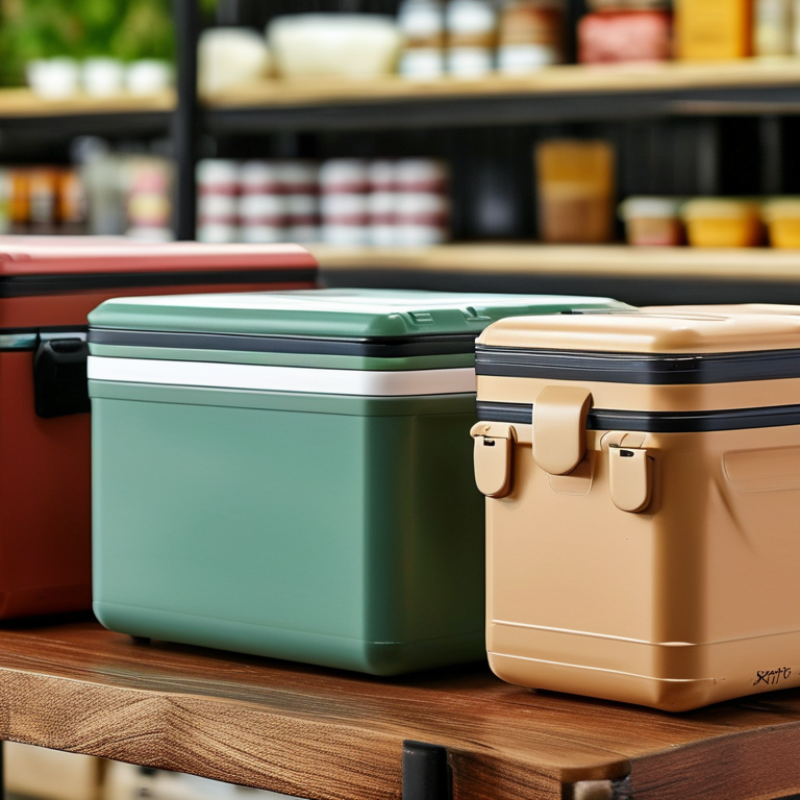
Food Cooler Definitions and Uses: Keeping TCS Foods at 5°C or Below (FDA)
Food coolers are temperature-controlled units designed to protect time/temperature control for safety (TCS) foods. Under FDA guidance, these foods should be held at 5°C (41°F) or below. Examples include meat, poultry, seafood, eggs, dairy products, cooked rice, and cut leafy greens. At warmer temperatures, harmful microorganisms can multiply quickly, even when food looks and smells normal.
For global buyers, a suitable cooler must match the product, climate, and delivery route. Look for reliable insulation, adjustable controls, visible temperature displays, and easy-to-clean interior surfaces. A unit used in a humid market may need stronger corrosion resistance. A delivery cooler also needs secure doors and enough battery or power capacity. Keep cold air moving. Do not pack products tightly against vents.
Temperature checks should happen with a calibrated probe, not only through the built-in display. Record readings during loading, transport, and storage. Pre-cool the cooler before adding food, and limit door openings. Raw meat should remain separated from ready-to-eat products. A cooler can show 5°C while food near the door is warmer. That detail is easy to miss. Supplier instructions also deserve careful review, especially for voltage, maintenance, and replacement parts. In practice, no cooler removes the need for disciplined handling. Mistakes still happen, and each temperature record should invite a closer look.
Food Cooler Use Cases: FDA Cold-Holding Limit for TCS Foods
Time/temperature control for safety (TCS) foods must be maintained at 5°C (41°F) or below during refrigerated storage and display, according to the FDA Food Code. This reference applies to common chilled food categories such as dairy, seafood, poultry, prepared foods, and cut produce.
Reference threshold: 5°C or below. Actual storage requirements may vary by product, packaging, local regulations, and manufacturer guidance.
Global Market Context: 13.2% of Food Is Lost Before Retail (FAO)
Food loss is a logistics problem, not only a farming problem. The FAO’s 2024 SDG reporting estimates that 13.2% of food is lost before retail globally. That percentage represents warm loading docks, delayed vehicles, damaged insulation, and unstable temperatures. For global buyers comparing the top 10 food cooler suppliers, these details matter more than appearance.
A reliable supplier should provide tested thermal performance, food-grade materials, drainage design, and clear temperature data. The UNEP Food Waste Index Report 2024 recorded 1.05 billion tonnes of food waste in 2022, showing how much efficiency remains missing. Reusable insulated containers can reduce exposure during short transport stages. However, they cannot repair poor handling.
A cooler may meet laboratory standards and still fail beside a sunny warehouse door.
Buyers should request drop-test results, insulation thickness, payload capacity, cleaning instructions, and performance records at different ambient temperatures. Ask how replacement parts are supported across regions. This is often overlooked. The U.S. Department of Agriculture also emphasizes that temperature control is central to maintaining food quality and safety during distribution. Yet one specification sheet is not enough. Independent testing, shipment trials, and documented quality checks create stronger evidence. Some suppliers may offer impressive retention times, but real routes include opening, stacking, condensation, and human mistakes. That is where procurement decisions become less perfect, and more honest.
Supplier Evaluation Criteria: Capacity, Insulation, Certifications, MOQ, and Lead Time
Top 10 Food Cooler Suppliers for Global Buyers
Evaluating food cooler suppliers requires more than comparing catalogue prices. I review internal volume, usable capacity, insulation thickness, gasket quality, and drain design. A cooler may advertise 50 litres, yet baskets and curved walls reduce practical storage. Ask suppliers for measured capacity, temperature test data, and photographs of loaded units. Small details matter.
Insulation performance should be tested under realistic conditions, such as a 30°C warehouse and repeated lid openings. Foam density, wall construction, and seal compression affect cooling time. Request certification documents relevant to the destination market, including food-contact safety, electrical safety, or quality management records. Check certificate numbers and issuing bodies. Files alone are not proof.
MOQ can change the entire sourcing decision. A low unit price may require 500 pieces, while a smaller order carries setup charges. Confirm whether colours, logos, packaging, and accessories have separate MOQs. Lead time must include sampling, production, inspection, and shipping preparation. Get each stage in writing. A supplier promising seven days may mean only factory assembly. That caused confusion in one purchasing review. A spreadsheet can still mislead. Build a timeline with buffer days, especially before seasonal demand. Ask how shortages, failed inspections, and replacement parts are handled. Their answer often reveals operational maturity better than a polished presentation.
Top 10 Food Cooler Suppliers for Global Buyers - Supplier Evaluation Criteria: Capacity, Insulation, Certifications, MOQ, and Lead Time
| Rank | Supplier Profile | Primary Product Focus | Capacity Range | Insulation Construction | Common Certifications / Compliance | Typical MOQ | Sample Lead Time | Bulk Lead Time | Evaluation Score |
| 1 | Supplier Profile A | Soft-sided food delivery coolers | 8–45 L | EPE foam, 6–10 mm; aluminum foil lining | ISO 9001; REACH; RoHS; food-contact material documentation | 500 units | 7–10 days | 25–35 days | 9.2/10 |
| 2 | Supplier Profile B | Rotomolded ice chests | 20–100 qt | Double-wall LLDPE shell with injected PU foam | ISO 9001; LFGB or FDA food-contact options; drop-test reports | 300 units | 10–14 days | 35–50 days | 9.0/10 |
| 3 | Supplier Profile C | Insulated grocery and meal bags | 6–35 L | PE foam or EPE foam; PEVA inner liner | BSCI or SMETA audit availability; REACH; CPSIA for applicable products | 1,000 units | 7–12 days | 25–40 days | 8.8/10 |
| 4 | Supplier Profile D | Commercial catering transport boxes | 20–120 L | Expanded polypropylene or PU-insulated hard shell | ISO 9001; HACCP-based production controls; food-contact declarations | 200 units | 14–18 days | 40–55 days | 8.7/10 |
| 5 | Supplier Profile E | Reusable insulated food shipping containers | 10–80 L | PU foam core with waterproof textile or HDPE exterior | ISO 9001; ISTA packaging test options; REACH; RoHS | 500 units | 10–15 days | 30–45 days | 8.5/10 |
| 6 | Supplier Profile F | Foldable picnic and beverage coolers | 12–40 L | EPE foam, 5–8 mm; insulated PEVA liner | BSCI or Sedex audit availability; REACH; food-contact test reports | 800 units | 7–10 days | 25–35 days | 8.3/10 |
| 7 | Supplier Profile G | Personal lunch coolers and bento bags | 3–15 L | PE foam or cotton insulation; aluminum-coated liner | REACH; LFGB or FDA liner testing; social compliance audit options | 1,500 units | 8–12 days | 25–40 days | 8.1/10 |
| 8 | Supplier Profile H | Heavy-duty outdoor cooler bags | 20–55 L | Closed-cell foam; TPU or PEVA waterproof liner | ISO 9001; REACH; RoHS; waterproof and seam-strength test reports | 600 units | 10–14 days | 30–45 days | 7.9/10 |
| 9 | Supplier Profile I | Medical and temperature-sensitive food carriers | 5–30 L | PU foam with reflective barrier; optional PCM inserts | ISO 9001; ISTA 7D or equivalent thermal test options; REACH | 300 units | 14–21 days | 40–60 days | 7.8/10 |
| 10 | Supplier Profile J | Promotional insulated coolers | 4–25 L | EPE foam; PEVA or aluminum foil lining | REACH; RoHS; food-contact declarations where applicable | 2,000 units | 7–10 days | 20–35 days | 7.5/10 |
Note: Capacity, MOQ, and lead time are representative supplier-screening benchmarks. Certification availability should be verified against the specific product, material, destination market, and purchase order.
Top 10 Food Cooler Suppliers: Product Lines, Regions, and Target Applications
For global buyers, the top ten food cooler suppliers should be assessed by product lines, service regions, and real use cases. Their portfolios commonly include insulated shipping boxes, passive coolers, plug-in cabinets, roll-in blast chillers, refrigerated containers, and modular cold rooms. GCCA’s Global Cold Storage Capacity Report recorded about 719 million cubic meters of storage capacity worldwide, showing the scale of temperature-controlled food logistics. However, capacity alone proves little. Buyers should verify pull-down time, temperature recovery, insulation thickness, energy consumption, spare-part access, and cleaning design.
Regional coverage changes purchasing risk. North American suppliers often focus on retail cases, meal delivery, and large distribution centers. European providers frequently emphasize energy efficiency and compact urban equipment. Asia-Pacific suppliers serve seafood, produce, and high-volume food processing. Middle Eastern and African markets need durable systems for heat, dust, and unstable power. Latin American buyers often prioritize transport coolers for meat, dairy, and fresh exports. UNEP’s Global Cooling Watch 2023 reported that cooling demand could more than triple by 2050 without stronger efficiency measures. That makes refrigerant choice and lifecycle cost increasingly important. Field experience also suggests a less obvious issue: the cheapest cooler may create higher losses through weak seals, slow servicing, or poor loading practices. No ranking is flawless. Supplier claims still require temperature logs, trial shipments, and references from similar applications.
Global Buyer Comparison: Temperature Retention, Costs, Logistics, and Compliance
Global buyers comparing the top ten food cooler suppliers should examine temperature retention before reviewing prices. Ask for test data under realistic ambient conditions. A cooler holding 2–8°C for 24 hours may perform differently during a 40°C summer delivery. Check insulation thickness, seal quality, interior capacity, and reusable ice-pack compatibility. Request independent test reports, not only sales claims.
Cost comparison must include the full landed price. Calculate the unit cost, minimum order quantity, packaging, freight, insurance, duties, and replacement rates. A cheaper cooler can create higher expenses if lids crack or insulation weakens. Review production experience, quality-control records, and sample consistency. Logistics also matter. Confirm lead times, pallet dimensions, export documents, and available shipping methods. Compliance checks should cover food-contact materials, labeling, chemical restrictions, and destination-market requirements. Requirements vary by country. Verify them with qualified local advisers.
Tips: Test samples yourself. Fill one cooler with prepared packs, record temperatures hourly, and repeat the test after rough handling. Compare results across suppliers using the same conditions. Keep written evidence. I once trusted a polished specification sheet too quickly; the real weakness appeared around the zipper after repeated opening. That mistake was avoidable. Suppliers should explain corrective actions clearly, even when their first sample is imperfect.


 English
 Polski
  Čeština