Top 10 Directional Antenna Suppliers for Global Buyers
Choosing a Directional Antenna supplier is not just a matter of comparing headline gain. The right choice depends on operating frequency, beamwidth, polarization, mounting conditions, and the environment where the antenna will be installed. A compact panel antenna may suit a rooftop link, while a ruggedized yagi may better fit a remote site exposed to wind and rain. Details matter.
As antenna theorist Constantine A. Balanis writes, an antenna is “the transitional structure between free-space and a guiding device.” That idea is useful when comparing suppliers: an antenna must work as part of a complete radio system, not as an isolated product. Buyers should check published radiation patterns, gain figures, connector options, mechanical drawings, and test documentation. They should also ask how products are supported across regions. Clear answers can matter as much as an impressive specification sheet.
This guide introduces ten suppliers serving global buyers and highlights the differences that can shape a shortlist. It focuses on product range, technical transparency, customization, manufacturing capabilities, and practical support. No single supplier is best for every deployment. Published specifications may also use different test conditions, making direct comparisons imperfect. That is worth remembering. Before purchase, confirm the exact model, frequency band, installation requirements, and available documentation with the supplier. The list is a starting point, not a substitute for engineering review.
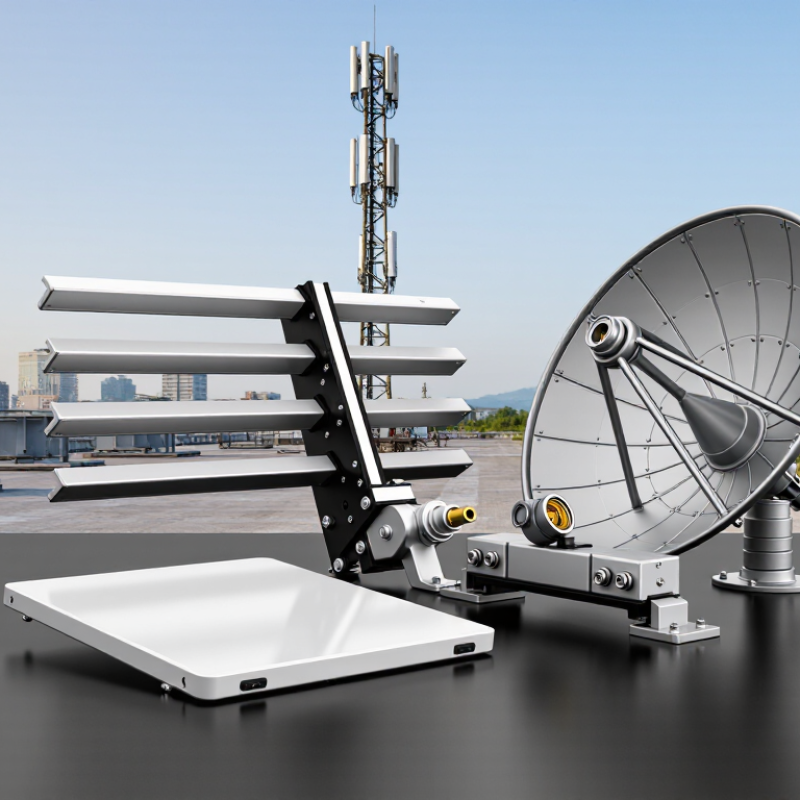
Directional Antennas: Core Designs and Applications
Directional antennas concentrate radio energy toward a chosen area instead of spreading it evenly. This can improve link quality and reduce interference from unwanted directions. The trade-off is narrower coverage. A small alignment error may weaken a point-to-point connection.
Different designs suit different jobs. Yagi antennas use parallel elements and work well for fixed links and telemetry. Panel antennas are compact, with a flatter profile that can simplify mounting on walls or poles. Parabolic dishes provide high gain for long-distance links, but need careful aiming and sturdy supports. Horn antennas are useful in measurement setups and some specialized communications systems. Each design has limits.
Applications range from connecting two buildings to monitoring equipment across a site. Buyers should compare frequency range, gain, beamwidth, polarization, weather protection, and connector type. The cable matters, too: a long, thin feed line can waste signal before it reaches the antenna. Peak gain alone is not enough. Installation details often change real-world performance, and a clean specification sheet cannot show every obstacle, such as nearby metal or moving foliage. Local radio requirements should also guide equipment choice. There is no perfect antenna. A practical selection starts with the link distance, mounting conditions, and the signal area that actually needs coverage.
Typical Gain Ranges by Directional Antenna Design
Indicative gain ranges in dBi vary with frequency, dimensions, and implementation. Yagi antennas are commonly used for VHF/UHF television and point-to-point links; log-periodic antennas for broadband reception and measurements; horn antennas for microwave testing and radar; panel antennas for wireless access; and parabolic reflectors for satellite links and radio astronomy.
Key Criteria for Evaluating Global Antenna Suppliers
For global buyers, supplier evaluation should begin with verified performance, not a catalog’s headline gain. Request frequency-specific gain, half-power beamwidth, front-to-back ratio, polarization data, and return loss. Ask whether results come from calibrated anechoic-chamber tests and whether the report covers the exact model and radome. Small differences matter. A narrow beam can improve link focus, but makes alignment harder on a swaying rooftop mast. Confirm connector options, wind-load limits, salt-spray resistance, operating temperature, and production tolerances for the destination environment.
Use independent benchmarks carefully. ITU-R Report M.2410-0 sets IMT-2020 peak-rate targets of 20 Gbit/s downlink and 10 Gbit/s uplink; these are network-level targets, not antenna acceptance limits. GSMA’s Mobile Economy 2024 projected 5.5 billion 5G connections by 2030, underscoring the value of suppliers that can support changing deployment needs. Request traceable test records, quality-control procedures, lead-time commitments, and clear warranty terms. Compare equivalent frequency bands and test conditions; supplier datasheets do not always use comparable methods. That gap deserves scrutiny. A practical review should also check sample-to-production consistency, spare-part availability, and technical support across time zones.
Profiles of Ten Directional Antenna Suppliers
The ten supplier profiles represent different engineering strengths, not a universal ranking. A June 2024 industry mobility report recorded 25% year-over-year mobile data traffic growth in late 2023 and projected 130 exabytes monthly by 2029. Those figures indicate network pressure, not antenna sales.
One supplier type focuses on sector panels for cellular sites, where beamwidth and passive intermodulation performance matter.
Another builds parabolic dishes for narrow, long-distance links.
Broadband log-periodic suppliers suit multi-band measurements and installations.
MIMO-array specialists manage multiple polarizations and port isolation.
Ruggedized outdoor suppliers prioritize sealed connectors and corrosion resistance.
Details matter.
Indoor antenna providers design ceiling or wall units for even coverage.
Microwave-backhaul suppliers optimize gain and alignment.
Small-cell specialists favor compact housings and unobtrusive mounting.
Custom OEM suppliers adapt dimensions, connectors, and radomes to a buyer’s design.
Engineering-led suppliers provide chamber testing and pattern data.
Ask for measured gain, beam plots, and environmental ratings; catalog figures alone can mislead. Even a strong datasheet may not predict performance beside metal cladding.
Comparing Product Range, Compliance, and International Support
Global buyers should compare directional antenna suppliers by usable coverage, not catalogue size alone. GSMA Intelligence’s The Mobile Economy 2024 projects 5.5 billion 5G connections by 2030. That growth makes frequency coverage, beamwidth, and polarization key checks. Match each antenna’s stated bands to the actual deployment; a broad range can still leave gaps.
Ask for measured gain, radiation patterns, connector details, and environmental test records. Check whether compliance documents apply to the exact model and destination market. Requirements differ across regions, so a certificate for one market may not settle another’s review. Look closely at test dates and product revisions. Small details matter.
International support is practical, not decorative. Confirm response times, replacement-part availability, installation guidance, and warranty handling across time zones. Request clear lead-time estimates and documentation in usable formats. In a comparison table, score product fit, evidence, and service separately. A weakness in this method: paper scores cannot predict every field condition. A careful buyer should ask how suppliers handle a failed unit on a remote site, then verify the answer in writing.
Purchasing Considerations for Cross-Border Buyers
Cross-border buyers should compare directional antennas by verified performance, not headline gain alone. Confirm the operating frequency, beamwidth, polarization, connector type, and mounting arrangement against your system drawings. A narrow beam may improve link focus, but it also demands accurate alignment on site. Request a datasheet and a test report for the exact configuration being quoted. Small differences matter.
Shipping and documentation can change the real purchase cost. Ask for the packed dimensions, gross weight, country of origin, and a clear list of included accessories. Confirm who handles export packing, insurance, and customs paperwork before paying a deposit. Delivery estimates should distinguish production time from transit time. A low quote may exclude cables or brackets, and that can cause avoidable delays. Warranty terms, replacement-part availability, and the process for reporting transit damage deserve written answers.
Tips: Request a sample or pre-shipment inspection when practical. Compare its connector, finish, and dimensions with the approved specifications. Check that invoices and packing lists use consistent product descriptions. Clarify payment currency and bank fees in advance. Keep one detail in mind: a test result is useful only when its test conditions match your installation. I would not treat a polished brochure as proof by itself. The paperwork can still be incomplete, so review it carefully.


 English
 Polski
 Čeština