
China’s leading Continuous carbon fiber production line suppliers are competing on more than equipment price. Buyers now examine process stability, energy consumption, automation, and long-term technical support. A reliable line must guide precursor fibers through oxidation, carbonization, surface treatment, sizing, drying, and winding without damaging filament alignment. Every stage matters.
Dr. R. Byron Pipes, a respected composites engineer and former university research leader, has stated, “Manufacturing is where material performance becomes product performance.” This principle fits carbon fiber production closely. A high-strength specification means little if tension fluctuates, furnace temperatures drift, or sizing coverage becomes uneven. Small defects can appear later as broken filaments, inconsistent tow spread, or unstable composite performance.
The best China-based suppliers usually provide more than furnaces and control cabinets. They should demonstrate pilot-line results, documented quality procedures, traceable components, and responsive commissioning teams. Ask for evidence. Request production samples, energy data, maintenance records, and realistic output figures. Factory photographs are not enough.
Important details often hide in plain sight. Look at roller surfaces, tension sensors, exhaust treatment, software alarms, and spare-part availability. These features affect daily production, not just brochure performance. Some supplier claims may still need independent verification. That is worth admitting.
This guide compares leading suppliers through a practical lens. It considers engineering depth, customization, operating reliability, and after-sales service. The strongest choice may not offer the fastest line. It may offer the steadiest one.
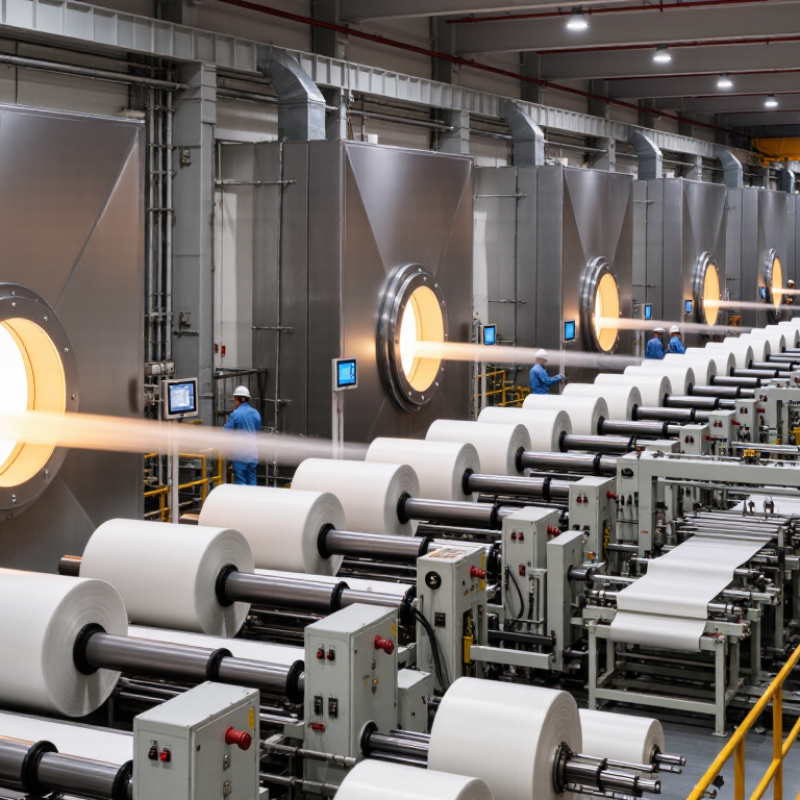
Continuous carbon fiber production converts a precursor into an endless, high-strength tow. Most lines begin with polyacrylonitrile (PAN) fibers. The tow passes through stabilization ovens at roughly 200–300°C. It then enters inert-atmosphere carbonization zones, commonly reaching 1,000–1,500°C. Some grades require graphitization above 2,000°C. Surface treatment and sizing follow before winding.
“Continuous” means the tow moves through each stage without cutting. Tension control is critical. Uneven tension can create fuzz, breaks, or inconsistent strength. According to Carbon Composites e.V.’s 2024 market report, global carbon fiber demand approached 125,000 tonnes in 2023. That scale increases pressure on production lines to reduce energy loss and improve yield. A technical review in Composites Part A reports that carbon fiber conversion can require more than 100 MJ per kilogram, depending on the precursor and furnace design. The number varies. This is where supplier comparisons become misleading.
Tips: Ask for line data, not only rated speed. Check stabilization residence time, furnace temperature uniformity, tow-width control, and actual scrap rates. Request test records for tensile strength, modulus, sizing content, and batch consistency. A line may promise high output, yet unstable tension can quietly reduce usable production. Energy recovery also deserves attention. It is often discussed less than speed, perhaps unfairly. Pilot trials with your own precursor remain valuable because laboratory results rarely transfer perfectly to continuous manufacturing.
China’s leading continuous carbon fiber production lines increasingly depend on process control, not simply furnace size. MarketsandMarkets estimated the global carbon fiber market at about USD 4.7 billion in 2023, with continued growth through 2028. That expansion raises pressure on Chinese suppliers to deliver stable quality and lower energy use.
The line begins with PAN precursor unwinding and controlled tension. Small tension changes can create uneven tow spreading. Oxidation usually operates around 200–300°C in carefully managed air. Carbonization follows in an inert atmosphere, commonly between 1,000 and 1,600°C. Higher-performance grades may add graphitization above 2,000°C. Inline temperature sensors, oxygen monitoring, and automatic tension correction are essential technologies.
Sizing application comes later. It improves handling and bonding with resin. Recent production lines also use digital traceability, infrared inspection, and closed-loop furnace controls. The 2024 Carbon Fiber Market report by Grand View Research identifies aerospace, wind energy, and automotive uses as major demand areas. Yet energy consumption remains a practical weakness. A larger furnace is not automatically a better furnace. In plant trials, uneven airflow can still produce inconsistent tensile strength. Suppliers should therefore provide data from continuous runs, including yield, line speed, energy use, and batch variation. Laboratory samples can look excellent. Production reality is less forgiving.
Evaluating China-based continuous carbon fiber production line suppliers requires more than comparing equipment prices. The 2024 JEC Observer reported continued growth in global carbon fiber demand, driven by wind energy, aerospace, and automotive applications. This growth raises expectations for stable output, not impressive brochures. Ask suppliers for verified data on line speed, tensile strength, modulus, yield rate, and energy consumption. Request at least three operating references with similar tow sizes and precursor materials.
Inspect the process in detail. A reliable line should demonstrate controlled oxidation temperature, furnace uniformity, tension management, surface treatment, and winding accuracy. Production records matter more than showroom samples. Check whether the supplier measures uptime, scrap, power consumption, and batch variation. ISO 9001 certification supports process control, but it does not prove final fiber performance. Independent testing remains necessary. Small details matter.
Review engineering support before signing. Confirm commissioning schedules, operator training, spare-parts availability, software access, and response times for overseas service. The International Energy Agency’s 2024 clean-energy manufacturing analysis highlights the importance of resilient supply chains and efficient industrial production. That principle applies here. Ask for factory acceptance and site acceptance testing, with measurable pass criteria. A polished factory tour can still hide weak commissioning discipline. My evaluation would also include a paid pilot run, although this adds time and cost. It may reveal tension drift, uneven coating, or unstable furnace control before full investment. Supplier comparisons are imperfect, but documented evidence is safer than confidence.
China’s continuous carbon fiber production lines now cover PAN precursor conversion, stabilization, carbonization, surface treatment, sizing, and winding. Supplier capability differs sharply across these stages. A serious equipment builder should provide pilot trials, furnace temperature mapping, tension records, and stable fiber property data, not only a polished factory video.
Future Market Insights reported continued double-digit growth in the global carbon fiber market during the 2020s. That pressure is pushing buyers toward higher line speeds and lower energy use. A typical evaluation should examine oxidation furnace length, carbonization atmosphere control, roller alignment, and online tension feedback. These details affect tensile strength, modulus, fuzz, and production yield. Small variations become visible on a 24-hour line.
Equipment options range from compact pilot lines to multi-furnace industrial systems. Pilot units suit new precursor formulas and process experiments. Industrial lines need automatic tow spreading, closed-loop gas control, off-gas treatment, and synchronized winding. The International Energy Agency’s industrial efficiency studies repeatedly emphasize process heat and energy management, which matters because carbonization consumes substantial power. However, supplier claims are not always comparable. Some quote maximum speed; others quote tested production speed. Ask for both. Request a witnessed run using your own precursor. That extra step may reveal unstable sizing or uneven tow tension.
| Supplier Capability Area | Common Equipment or Configuration | Typical Technical Range | Suitable Product Scope | Key Selection Criteria | Operational Notes |
|---|---|---|---|---|---|
| Precursor Tow Handling | Creel frames, tow guides, tension-control units, and automatic break detection | 12K to 50K precursor tow positions per line section | Standard industrial-grade carbon fiber and high-throughput conversion lines | Stable tow tension, low fuzz generation, accurate alignment, and expandable creel capacity | The required creel layout depends on tow size and the number of parallel production lanes. |
| Oxidation and Stabilization | Multi-zone hot-air oxidation ovens with independent temperature and airflow control | Typically about 180–300°C, arranged across several controlled zones | PAN-based precursor conversion before carbonization | Uniform airflow, residence-time control, heat recovery, and reliable exhaust treatment | Temperature uniformity is essential for consistent stabilization and reduced filament breakage. |
| Low-Temperature Carbonization | Inert-gas tubular or multi-chamber furnace with sealed entry and exit sections | Approximately 300–900°C under nitrogen or another suitable inert atmosphere | General-purpose carbon fiber grades requiring controlled conversion of stabilized PAN | Oxygen exclusion, furnace sealing, gas-flow balance, thermal uniformity, and line-speed stability | Nitrogen purity and leakage control directly affect surface quality and process safety. |
| High-Temperature Carbonization | Graphite-lined or high-temperature furnace with controlled inert-gas circulation | Usually about 1,000–1,600°C, depending on the target grade | Higher-modulus or higher-strength carbon fiber products | Maximum operating temperature, hot-zone length, power efficiency, and graphite-component life | Not every line requires a high-temperature stage; the specification should match the final fiber grade. |
| Surface Treatment | Electrochemical oxidation bath, controlled-current system, rinsing section, and conductivity monitoring | Adjustable treatment intensity based on fiber type and resin system | Fibers intended for improved adhesion with epoxy, thermoplastic, or other polymer matrices | Bath uniformity, current-density control, water quality, chemical management, and drying performance | Surface treatment must be matched to the intended sizing chemistry and downstream composite process. |
| Sizing Application | Metered sizing applicator, immersion or kiss-roll system, squeeze rollers, and drying oven | Common sizing add-on levels are approximately 0.5–2.0% by fiber mass | Structural prepreg, filament winding, pultrusion, weaving, and thermoplastic compounding | Accurate add-on control, emulsion stability, drying temperature, and compatibility with the customer’s resin | Sizing selection is application-specific and should be validated through interfacial and processing tests. |
| Drying and Moisture Control | Hot-air drying oven with humidity monitoring and closed-loop temperature control | Common operating zones are roughly 80–180°C | Continuous lines requiring consistent sizing distribution and package quality | Residence time, air velocity, moisture removal, energy consumption, and prevention of fiber sticking | Excessive drying can damage sizing performance, while insufficient drying can cause package defects. |
| Take-Up and Winding | Precision godet rollers, traversing winder, tension feedback, and programmable package build | Line speed commonly ranges from several meters per minute to more than 20 m/min | Small trial packages through continuous industrial production | Winding tension, package density, traverse accuracy, spool changeover, and fiber spreading control | Actual speed is limited by precursor type, furnace residence time, target properties, and package requirements. |
| Process Control System | PLC-based control with HMI, recipe management, data logging, alarms, and remote diagnostics | Independent monitoring of temperature, tension, speed, gas flow, pressure, and current | Laboratory, pilot, and high-volume continuous production lines | Control-loop response, historian functions, cybersecurity, sensor redundancy, and ease of recipe transfer | Traceable process data supports quality investigations, qualification, and repeatable scale-up. |
| Environmental and Safety Systems | Exhaust treatment, nitrogen monitoring, interlocked furnace doors, fire protection, and cooling-water systems | Designed according to local emissions, pressure, fire, and occupational-safety requirements | All continuous carbon fiber production configurations | Exhaust capacity, oxygen detection, emergency shutdown, heat shielding, and maintenance access | Safety equipment should be engineered with the furnace atmosphere, solvent or sizing chemistry, and plant layout. |
| Quality Inspection | Online tension monitoring, filament-break detection, appearance inspection, and laboratory testing equipment | Typical tests include tensile strength, tensile modulus, elongation, sizing content, and linear density | Qualification batches, process validation, and routine production control | Measurement repeatability, calibration procedures, sampling frequency, and compliance with applicable test standards | Mechanical properties should be verified using recognized carbon-fiber test methods and documented sampling plans. |
| Line Scale and Output Planning | Laboratory-scale, pilot-scale, or multi-lane industrial line architecture | Output depends on tow count, line speed, fiber yield, denier, and operating hours | Process development, customer qualification, commercial production, and capacity expansion | Available floor space, utility demand, future lane expansion, maintenance access, and total cost of ownership | Suppliers should provide a mass-balance calculation rather than relying only on nominal machine speed. |
China Top Continuous Carbon Fiber Production Line Suppliers?
Purchasing, Installation, and Quality Assessment Criteria
Purchasing a continuous carbon fiber line requires more than comparing prices. Request a detailed process flow, including fiber unwinding, resin impregnation, heating, cooling, and pulling. Confirm the planned tow count, line speed, temperature range, and compatible resin systems. Ask for verified output data from a similar installation. Paper specifications can look impressive.
Inspect the supplier’s engineering records and service capacity. The control system should record tension, temperature, pressure, and production speed continuously. During installation, check foundation levels, cable routing, guarding, and emergency stops. A practical acceptance test should run several hours with your actual fiber and resin. Operators need hands-on training, not only translated manuals. Keep critical heating elements and sensors available.
Quality assessment should include fiber alignment, resin distribution, void content, surface appearance, and dimensional stability. Cut samples from different production periods, not one convenient batch. Use calibrated equipment for tensile, flexural, and thermal testing. Compare results with agreed specifications and trace each sample to its process settings. I would also inspect startup waste carefully. It often reveals unstable tension or incomplete impregnation. No checklist is perfect. A supplier may meet the numbers while making maintenance unnecessarily difficult. Leave room for operator feedback, process adjustments, and a second review after three months of production.
Recommended purchasing priorities for comparing continuous carbon fiber production lines. Quality consistency and process stability receive the highest weighting, followed by installation capability and production capacity.
The weighting framework can be used during technical audits, quotation reviews, factory acceptance testing, installation assessment, and final supplier qualification.
