
Choosing the right Plastic Wheel starts with the job it must perform, not its appearance. A small caster may roll smoothly on a showroom floor yet struggle under a loaded cart. Check the total weight, how many wheels share it, and whether the load shifts during turns. Allow for uneven weight distribution; four wheels do not always carry equal shares. That detail matters.
The floor and working conditions narrow the options. Hard wheels can roll easily on smooth concrete, while softer treads may grip better and reduce vibration. On tile, a quiet wheel can make a busy workspace more comfortable. Measure the wheel’s diameter and mounting space, then confirm that its bearing and rated capacity suit the equipment. Moisture, cleaning chemicals, heat, and frequent impacts can also affect material choice. A supplier’s specifications are useful, but verify that they describe the actual operating conditions.
There is no perfect wheel for every cart. Catalog descriptions can make trade-offs look simpler than they are. A wheel designed for low rolling resistance may not provide the cushioning or traction you need. If possible, test a sample with the real load on the actual floor. Listen for rattling, watch for wobble, and note how easily the cart starts and turns. Small differences show up quickly. A careful choice can improve handling and reduce premature wear, but the right answer depends on the equipment, environment, and routine—not on one material name alone.
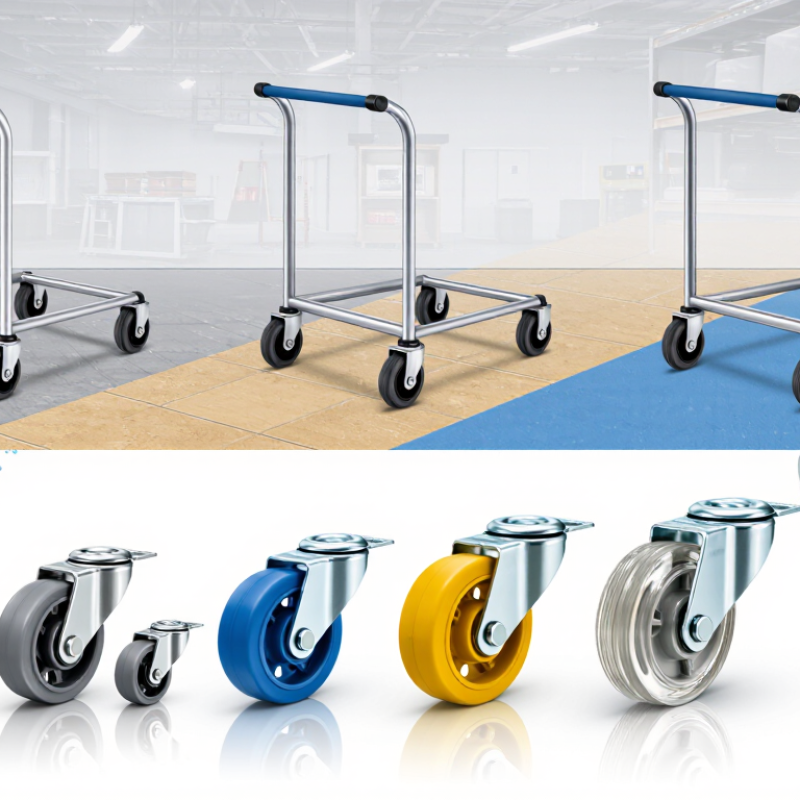
Start with the real working load: cart, payload, and any tools or fixtures. A 600 kg loaded cart resting unevenly on three wheels puts about 200 kg on each wheel, not 150 kg. That simple calculation is only a baseline; thresholds, bumps, and impacts can raise the load. Check the wheel’s rated capacity and leave an appropriate margin for actual use. ISO 22883:2004 covers castors and wheels for applications up to 1.1 m/s, but its test scope does not confirm suitability for every floor or duty cycle. Small details matter.
Look closely at the route. Smooth concrete may suit a harder plastic wheel, while tile joints, grit, or floor debris can increase vibration and rolling resistance. Softer materials may travel more quietly, but can wear faster under heavy loads. Consider temperature, moisture, oils, cleaning chemicals, travel speed, and daily operating hours; each can change wheel performance. A wheel that rolls well in a showroom may struggle on a damp loading-bay floor. That gap deserves a second look. Match the wheel to the toughest regular condition, then test a loaded cart on the actual route before choosing a full set. The test is not perfect, but it can reveal problems a catalogue rating misses.
Plastic wheels can look alike but behave differently under load. Nylon suits heavy-duty wheels because it is stiff and resists wear, though it can absorb moisture and change dimensions. POM usually offers stable sizing and smooth rolling. Polypropylene resists many chemicals, but its lower stiffness can mean more flex under a heavy cart. Polyurethane treads cushion bumps and reduce noise; they may also collect grit on rough floors.
Compare measured properties, not material names alone. CAMPUS polymer data, using ISO 527 tensile-test results, shows typical unfilled nylon 6/6 values around 75–85 MPa, POM around 60–70 MPa, and polypropylene around 25–35 MPa. Grade, temperature, and moisture shift those numbers. They are not wheel load ratings. Check the wheel maker’s stated capacity and test conditions before matching a material to a cart. No material wins every floor.
A useful check: roll a loaded sample over the actual surface. Listen for chatter. Inspect for flat spots after a few shifts. One common mistake is treating hardness as a guarantee of capacity; axle design, wheel diameter, and contact width matter too. I’d be cautious about choosing from a table alone. Tables don’t show a gritty warehouse corner or a damp loading bay.
Start with the route the wheels will travel. A larger diameter usually rolls more easily over floor joints, door thresholds, and small debris. It also raises the cart, so check shelf height and stability. Measure the tightest clearance, too. A wheel that barely fits on paper may rub during a turn.
Width affects both support and maneuverability. Wider wheels spread weight across more floor area, which can help on softer or uneven surfaces. But they need more side clearance and may make a compact cart harder to steer. Check the fork or mounting space before choosing. Small details matter.
For load capacity, divide the fully loaded weight by the number of wheels only as a starting point. A four-wheel cart may not share weight evenly, especially on an uneven floor or when pushed over a threshold. Choose wheels with capacity above the estimated load, and account for frequent starts, stops, and impacts. Test the setup with a realistic load. Watch for wobble, excess effort, or wheel deformation; my measurements have been wrong before, so a short trial can reveal what a spec sheet misses.
Before choosing plastic wheels, match the bearing to the real load and working conditions. ISO 281:2007 calculates a bearing’s basic rating life, L10, at 90% reliability; it is an estimate, not a guarantee for the whole wheel. Check the bearing type, bore, seal, and lubrication needs against the equipment’s axle and environment. Dust, washdowns, and long idle periods can change performance. Small detail, big effect.
Then check the mounting plate or stem, bolt pattern, wheel diameter, and available clearance. Measure the equipment, not just the old wheel; bent brackets can make a matching replacement sit crooked. Add the equipment’s weight and maximum payload, then allow for uneven load sharing across wheels. A four-wheel cart may briefly place most of its weight on three wheels over a rough floor. ISO 22883:2004 covers castors and wheels for applications up to 1.1 m/s, so confirm that operating speed and duty match the test conditions. Check the manufacturer’s rated capacity and test documentation, too. I would not treat a catalogue load figure as proof of suitability. The floor, turning radius, and shock from door thresholds matter. A trial under normal working conditions can reveal what a spec sheet misses.
Example fit check (mm): the bearing inner diameter should match the axle diameter, while the hub width and wheel diameter must fit within the available mounting space. These values illustrate the checks; measure your equipment before choosing a wheel.
A wheel that rolls smoothly in a dry warehouse may behave differently near wash stations, outdoor ramps, or chemical spills. Check the wheel material against actual exposure: water, oils, cleaning agents, temperature swings, and sunlight can affect wear or performance. “Plastic” covers many formulations, so ask for resistance data for the specific grade. Nylon, for example, can absorb moisture, which may alter its dimensions in some conditions.
Small details matter. A cart crossing a wet loading area needs more than a corrosion-resistant wheel; its tread, bearings, and seals also face water and grit. Check the rated load and operating-temperature range, then compare them with the heaviest real load and coldest or hottest working conditions. Leave a margin. Specifications rarely capture every rough floor or repeated impact.
Maintenance needs are easy to underestimate. Inspect wheels regularly for cracks, embedded debris, flat spots, and loosened fasteners. Remove grit before it scores the tread, and clean with a mild detergent unless the material supplier confirms another cleaner is compatible. Strong solvents can damage some plastics. I used to focus mostly on load capacity; that missed how quickly debris could affect rolling. Still, inspection intervals depend on use, and a monthly check may be too slow for a busy shift.
