
Carbon Fiber Components are used wherever low weight, high stiffness, and dependable performance matter. They appear in aircraft wings, racing bicycles, electric vehicles, wind-turbine blades, medical equipment, and industrial robots. A carbon fiber seat shell can feel rigid in the hand, yet remain much lighter than a comparable metal part. That difference can improve fuel efficiency, handling, or payload capacity.
Composite materials expert Paolo Feraboli has stated, “Carbon fiber is not simply a material; it is a way of designing structures.” This idea explains why engineers rarely choose carbon fiber only for its appearance. They study load paths, fiber direction, resin systems, impact risks, and manufacturing limits. A thin panel may perform well under planned loads but fail after a sharp impact. That uncomfortable detail matters.
Real applications demand trade-offs.
Carbon Fiber Components can be molded into tubes, panels, brackets, housings, shafts, and highly shaped aerodynamic parts. In aerospace, they help reduce structural weight while maintaining stiffness. In motorsport, they support faster acceleration and precise vehicle control. In consumer products, they add durability and a premium visual finish. However, carbon fiber is not automatically the best choice. Repairs can be difficult, production may require skilled labor, and poor fiber alignment can weaken the final component.
This article examines how these components work in practical industries. It also considers their limitations, costs, maintenance needs, and environmental questions. Performance figures alone do not tell the whole story. Good engineering begins with the actual requirement, not the material’s reputation.
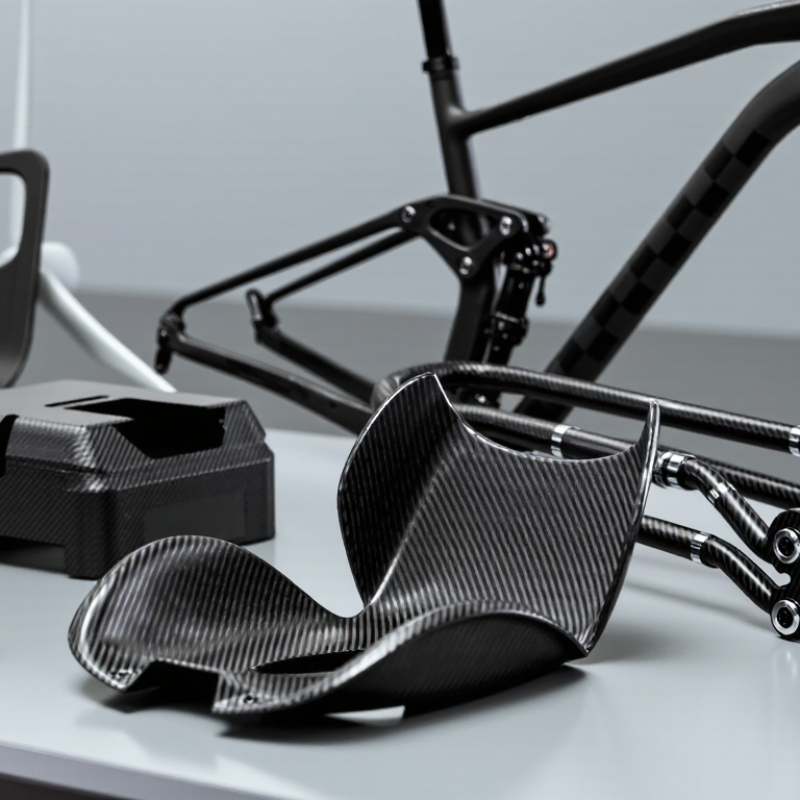
Carbon fiber components are engineered parts made from thin carbon filaments held inside a polymer resin. The fibers provide strength and stiffness, while the resin fixes their position and protects them. Unlike metal, carbon fiber is directional. Its performance depends on fiber alignment, layer thickness, and the quality of curing.
Manufacturers build components through cutting, layup, molding, and controlled heating. A panel may contain several layers, with each layer angled to manage different loads. Technicians inspect the surface for wrinkles, air pockets, and incomplete bonding. Small defects can reduce reliability. Careful inspection matters.
These components appear in vehicle panels, bicycle frames, aircraft interiors, robotic arms, and sporting equipment. They help reduce weight without sacrificing structural rigidity. In practical design work, engineers must study vibration, impact, temperature, and repeated stress. A lighter part is not automatically safer. That assumption can cause trouble.
Carbon fiber also has limitations. It can crack after a sharp impact, even when the outer surface looks acceptable. Repairing hidden damage requires proper testing, not guesswork. Carbon fiber may also create electrical contact issues beside certain metals, so designers often add protective layers. The material looks advanced, but its real value depends on accurate engineering, skilled production, and regular inspection.
Carbon fiber components serve where low weight, stiffness, and fatigue resistance matter. Common applications include aircraft panels, vehicle structures, wind-turbine spar caps, sporting equipment, and industrial robotic arms. The U.S. Department of Energy reports that a 10% vehicle weight reduction can improve fuel economy by roughly 6% to 8%. That benefit explains continued interest in composite structures. The International Energy Agency recorded nearly 14 million electric-car sales in 2023, increasing demand for lighter enclosures, platforms, and body components.
Manufacturing begins with polyacrylonitrile fibers, commonly called PAN. Producers stretch and stabilize these fibers through controlled heating. Carbonization then removes most non-carbon elements at temperatures often above 1,000°C. The resulting filaments may be thousands of times thinner than a human hair. Surface treatment improves bonding with resin. A sizing layer protects the fibers during handling.
Technicians place the fibers in planned orientations. Direction matters. Layers are then compressed using vacuum infusion, resin-transfer molding, or an autoclave process. Heat and pressure cure the resin around the reinforcement. Manufacturers inspect finished parts with ultrasonic testing or computed tomography. Small voids can reduce strength, even when the surface looks flawless. The process is not perfectly efficient. Fiber cutting creates scrap, and complex molds increase production time. Engineers still balance stiffness, repairability, cost, and recyclability. GWEC reported 117 gigawatts of new wind capacity in 2023, showing why larger composite structures need increasingly disciplined manufacturing control.
What Are Carbon Fiber Components Used For?
Key Properties of Carbon Fiber Components
Carbon fiber components are used where low weight and high stiffness matter. They appear in aircraft panels, racing structures, robotic arms, medical equipment, and sporting products. Their strength-to-weight ratio helps engineers reduce mass without sacrificing structural performance. In practical design work, this can improve handling, energy efficiency, and installation comfort.
The material also resists corrosion, fatigue, and many common chemicals. Its low thermal expansion helps parts maintain their shape during temperature changes. However, carbon fiber is not automatically stronger in every direction. Its performance depends on fiber alignment, resin quality, layer thickness, and manufacturing control. A poorly designed laminate can crack near holes or sharp edges. That limitation deserves more attention.
Tips: Match the fiber direction with the main load path. Inspect drilled areas carefully. Use suitable fasteners and avoid excessive tightening. Carbon fiber can also conduct electricity, so insulation may be necessary near sensitive components. Testing should include impact, vibration, and temperature exposure. Real-world damage is sometimes difficult to see, especially beneath the surface. That is where routine inspection becomes important.
| Component Use or Property | Typical Applications | Relevant Data or Characteristic | Practical Advantages | Important Considerations |
|---|---|---|---|---|
| Lightweight Structural Parts | Aircraft panels, vehicle body structures, bicycle frames, robotic arms, and sporting equipment | Carbon fiber composites commonly have a density of approximately 1.5–1.6 g/cm³, compared with about 2.7 g/cm³ for aluminum and about 7.8 g/cm³ for steel. | Reduces component mass while maintaining useful structural performance | Final weight and performance depend on fiber orientation, resin type, laminate design, and manufacturing method |
| High Specific Strength | Load-bearing frames, pressure vessels, automotive reinforcement parts, and aerospace structures | Carbon fiber has a high strength-to-weight ratio; the tensile strength of commercial fibers often falls within approximately 3–7 GPa, depending on grade. | Enables strong structures without adding unnecessary mass | Strength is directional in a composite and is lower across poorly aligned or unsupported directions |
| High Specific Stiffness | Aircraft wings, satellite structures, precision machine components, and high-performance frames | The tensile modulus of common carbon fibers is roughly 230–600 GPa, while composite laminate stiffness depends strongly on fiber alignment. | Limits bending and deflection in applications where dimensional stability matters | Very stiff laminates can be less tolerant of impact damage and may require carefully designed joints |
| Fatigue Resistance | Wind turbine blades, vehicle suspension components, sporting goods, and continuously loaded structures | Carbon fiber composites generally retain a high proportion of their static strength under repeated loading when properly designed and protected. | Supports long service life under cyclic mechanical loads | Fatigue performance can be reduced by impact damage, moisture, poor bonding, manufacturing defects, or stress concentrations |
| Low Thermal Expansion | Optical benches, precision instruments, antenna supports, and dimensional-control structures | Carbon fiber has a very low or even negative coefficient of thermal expansion along the fiber direction, while the composite value varies by laminate construction. | Helps maintain dimensional accuracy during temperature changes | Different expansion rates between carbon fiber parts and attached metals can create joint stresses |
| Vibration Damping | Vehicle panels, machine covers, musical instrument components, and aerospace equipment | The polymer matrix in a carbon fiber composite provides more damping than many metals, although damping depends on the resin, layup, and part geometry. | Can reduce resonant vibration and improve perceived smoothness or acoustic behavior | Carbon fiber is not always the best choice when maximum impact absorption or high inherent damping is required |
| Corrosion Resistance | Marine structures, chemical-processing equipment, bridges, pipes, and outdoor infrastructure | Carbon fiber itself does not rust, and many resin systems provide resistance to moisture and chemicals. | Can lower maintenance requirements compared with unprotected steel in suitable environments | Carbon fiber can cause galvanic corrosion when it contacts certain metals, so electrical isolation may be necessary |
| Electrical Conductivity | Electrostatic discharge paths, electromagnetic shielding, heating elements, and electrically conductive structures | Carbon fibers are electrically conductive, but the conductivity of a finished composite varies with fiber content, orientation, resin, and contact design. | Allows some components to provide conductive or shielding functions in addition to structural support | Electrical conductivity is anisotropic and generally differs from that of metals; insulation may be required near sensitive equipment |
| Pressure and Energy Storage Structures | Compressed-gas cylinders, hydrogen storage vessels, flywheel systems, and accumulator components | The high specific strength of carbon fiber makes it suitable for filament-wound pressure vessels and rotating structures. | Provides efficient structural reinforcement for high-pressure or high-speed applications | Requires strict control of winding patterns, resin quality, impact damage, inspection, and service limits |
| Wear and Surface Components | Protective panels, fairings, tooling, covers, and low-friction components when combined with suitable materials | Carbon fiber composites can provide a hard, stable surface, but wear resistance is primarily determined by the resin, coating, and counter-surface. | Offers low mass and good dimensional stability for protective or semi-structural parts | Uncoated carbon fiber composites may suffer surface wear, fiber exposure, or damage from abrasive contact |
| Temperature Performance | Engine-adjacent structures, industrial tooling, brake-related components, and high-temperature fixtures | The carbon fibers tolerate very high temperatures, but the polymer matrix typically limits continuous-use temperature; many standard epoxy systems are used below approximately 120–180°C unless specially formulated. | Maintains useful stiffness at moderate temperatures and can be tailored with high-temperature matrices | Resin selection, thermal cycling, fire performance, and heat transfer must be evaluated for the service environment |
| Manufacturing Flexibility | Complex shells, custom brackets, sandwich panels, molded housings, and integrated structural parts | Components can be produced using processes such as prepreg molding, resin transfer molding, compression molding, filament winding, and pultrusion. | Allows fiber placement and laminate thickness to be tailored to specific load paths | Tooling cost, production volume, cure control, repairability, and quality inspection affect total project cost |
Carbon fiber components are used where low weight, stiffness, and fatigue resistance matter. Aerospace engineers use them in fuselage panels, wing structures, seats, and interior frames. These parts can reduce mass while maintaining structural performance. However, they require strict inspection and controlled manufacturing. A small void inside a laminate can weaken confidence, even when the surface looks perfect. The International Air Transport Association’s 2024 industry outlook identifies efficiency as a continuing priority for aviation, increasing interest in lightweight structures. Carbon fiber also appears in medical equipment, robotics, and precision machinery, where stable movement matters.
Automotive manufacturers use carbon fiber for body panels, suspension parts, battery enclosures, and crash-management structures. The U.S. Department of Energy reports that a 10% reduction in vehicle weight can improve fuel economy by roughly 6–8%. Electric vehicles may benefit from this advantage because lower mass can support driving range. Wind energy is another major application. The Global Wind Report 2024 recorded more than 117 gigawatts of new wind capacity installed worldwide in 2023. Carbon fiber helps reinforce longer turbine blades, especially near areas exposed to repeated bending. It is not always the cheapest solution. Recycling remains difficult, and repair methods can vary widely. That practical gap deserves more attention.
What Are Carbon Fiber Components Used For?
Carbon fiber components appear wherever low weight and high stiffness matter. Engineers use them in aircraft panels, vehicle structures, bicycle frames, racing equipment, wind-turbine blades, and medical supports. A carbon fiber bracket can replace heavier metal while maintaining precise alignment. This saves energy during movement and may improve handling. The material also resists rust, which helps in humid or chemically exposed environments. It is not magic, though.
Carbon fiber has important limitations. Its strength depends on fiber direction, resin quality, and manufacturing accuracy. A poorly designed laminate may fail even when it looks flawless. Sharp impacts can cause hidden internal damage, especially after a small collision or tool drop. Repairs require controlled preparation and careful curing. The material can also conduct electricity, while its resin matrix may degrade under prolonged heat or ultraviolet exposure. Production and inspection costs remain higher than those of many conventional materials. A lighter part can still be the wrong part.
Tips: Match the fiber layout to the expected loads. Inspect impact areas with professional methods, not only visual checks. Protect exposed surfaces from heat, sunlight, and abrasion. Ask for verified strength data and documented manufacturing controls. Test the complete component, including bolts, joints, and bonded surfaces. Small details matter.
Carbon-fiber-reinforced polymer components are used in aircraft structures, automotive body panels, bicycle frames, sporting goods, wind-turbine parts, and industrial equipment. Their main advantage is low density combined with high stiffness and strength. A typical carbon-fiber composite has a density of about 1.6 g/cm³, compared with approximately 2.7 g/cm³ for aluminum and 7.85 g/cm³ for steel.
However, carbon-fiber components can be expensive to manufacture, are more difficult to repair, and may suffer hidden damage from impacts or delamination. Their performance also depends strongly on fiber direction, resin type, laminate design, and manufacturing quality.
