
For global buyers, choosing a welder is rarely just a price comparison. Workshop voltage, duty cycle, repair access, and operator skill all affect performance. An Inverter Igbt Welder uses insulated-gate bipolar transistor technology to switch power electronically, enabling compact designs and controlled output. That matters when a machine must fit on a crowded service bench or travel between job sites.
Market data offers useful context, but it should not be mistaken for a purchasing specification. Fortune Business Insights’ welding equipment market report estimates that the global market was worth about USD 16.49 billion in 2023 and projects continued growth through 2032. Estimates differ across research firms, partly because they define equipment categories differently. Still, the wider trend points to sustained demand from construction, manufacturing, and maintenance work. Buyers should verify every machine’s rated input, output range, and duty cycle against its own nameplate and manual.
This guide compares inverter IGBT welder types for different applications, from portable stick units to multi-process machines. A small fabrication shop may value stable low-current control; a field crew may care more about weight, generator compatibility, and a readable control panel in bright sunlight. Details matter. Not every advanced feature pays for itself, and a low purchase price can hide costly service delays. That is an imperfect trade-off worth examining. The right choice depends on the actual workload, local technical support, and the people who will use the machine every day.
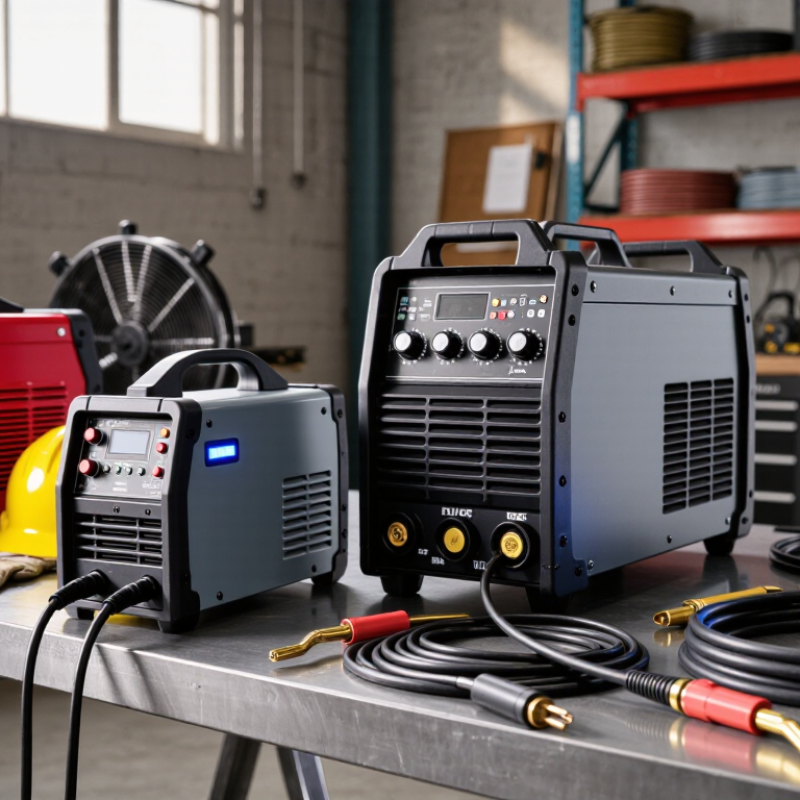
An inverter IGBT welder uses electronic switches called insulated-gate bipolar transistors to control welding power. It converts incoming AC power into DC, switches that current at high frequency, then adjusts the output for the arc. That’s the idea. The exact circuit differs by model, so “IGBT” alone does not tell you how well a machine welds.
Compared with many older transformer welders, inverter designs can be lighter and offer finer current adjustment. A buyer welding 3 mm steel, for example, may value a steady low-current arc for short tack welds. Still, check the rated duty cycle, input voltage, electrode range, and cooling requirements before choosing. A compact case can be useful on a crowded bench, but it cannot compensate for an undersized power supply or poor ventilation.
The numbers deserve a closer look. A machine’s maximum current may be available only briefly, while its duty-cycle rating describes operation over a ten-minute period. Also compare the stated input range with the supply where the welder will be used; regional voltage and frequency vary. Specs can look reassuring on paper, yet cable length and real workload matter too. That part is easy to overlook.
How Inverter IGBT Welding Technology Works
An inverter IGBT welder converts incoming AC power into DC, then switches that current at high frequency. IGBT transistors act like fast electronic gates, controlling how electrical energy moves through the machine. A compact transformer adjusts the voltage, and the output stage supplies welding current suited to the selected process. Feedback circuits monitor the arc and make rapid corrections when conditions change. The result is often a smaller, lighter power source than a traditional transformer welder. Not magic—just controlled switching.
In practical use, this fast response can help maintain a steadier arc when electrode distance changes slightly. A welder striking an arc on a steel plate may notice smoother starts and less spatter, though results depend on settings, consumables, and technique. Current adjustment is electronic, so small changes can be made without changing transformer taps. Yet an inverter still needs sensible airflow. Dust-packed vents or a hot workshop can trigger thermal protection and interrupt work. I have seen compact units treated as maintenance-free; that assumption is worth reconsidering. Keep the vents clear, use the correct input supply, and inspect cables for heat damage. Duty cycle also matters: a machine rated for a given current may need cooling breaks during sustained welding. Check the rating at the intended output, not just the maximum number on the panel.
This idealized waveform shows the first conversion stages in a single-phase inverter welder: 230 V RMS, 50 Hz AC input is rectified into pulsating DC, with an ideal peak of approximately 325 V. In the next stage, IGBTs switch the DC at high frequency—typically in the tens of kilohertz—so a smaller transformer can adjust the voltage and current for welding. Actual waveforms vary with the welder design, load, and input supply.
Inverter IGBT welders are grouped mainly by the welding process they support. MMA, or stick, models suit repair work and outdoor jobs because coated electrodes need no shielding-gas cylinder. They are compact, but electrode choice and arc control still affect the bead. Simple does not mean effortless.
TIG models offer precise control for thin stainless steel and neat visible joints. Many use a foot pedal or torch control, and operators must manage shielding gas carefully. MIG/MAG models feed wire continuously, making them useful for repeated welds on prepared steel. They need a wire feeder and, for many applications, shielding gas. Check which process a machine supports; “inverter IGBT” describes its power electronics, not its welding method.
Multi-process units can combine MMA, TIG, and MIG/MAG functions in one machine. This saves space in a small workshop, though each function may have different limits. Look closely at input voltage, rated output, duty cycle, and included accessories. A high current number alone can mislead: at a given setting, duty cycle shows how long the unit can weld before cooling. For buyers comparing models across markets, confirm local supply compatibility and spare-part access. Specs matter. Real work varies.
IGBT inverter welders convert incoming power efficiently and produce a controlled welding arc. Buyers should examine current range, duty cycle, input tolerance, and protection systems. A 200-amp model may suit maintenance work, light fabrication, and on-site repairs. A higher-output unit is better for structural steel and thicker sections. Duty cycle matters. A machine rated at 60% can weld for six minutes within a ten-minute period at its stated output.
Arc stability is equally important. Modern units can provide smoother starts, reduced spatter, and better control during low-current welding. Adjustable hot start helps prevent electrode sticking. Arc force can support a steadier weld when the gap changes. These features are valuable for carbon steel, stainless steel, and general workshop fabrication. Noise is usually lower. Weight still matters.
Application conditions can expose weaknesses that brochures miss. Construction crews often need compact welders with long cable reach, strong casing, and voltage fluctuation protection. Workshops may prefer higher duty cycles, digital adjustment, and reliable cooling for repeated jobs. Rural users should verify generator compatibility before purchase. A generous current rating does not guarantee performance. Ventilation, cable quality, electrode selection, and operator skill still affect the finished bead. Some published ratings also assume ideal temperature and power conditions, so buyers should request test data and clear operating limits.
The right IGBT welder depends on the work, not just its maximum amperage. A 2024 Fortune Business Insights report valued the global welding equipment market at about USD 20.67 billion in 2023, reflecting demand across varied applications. That market figure is context, not a buying specification. For repair work outdoors, a portable MMA inverter may suit coated electrodes and rougher conditions. For thin stainless steel, TIG offers finer control, though it requires more operator skill. MIG/MAG can support faster production when a suitable wire feeder and gas supply are available.
Check the input voltage before comparing models. A machine rated for a single-phase supply may not deliver its full output on a long, undersized extension lead. Read the duty cycle at the stated current and ambient temperature; a high peak-current number alone can mislead. IEC 60974-1 provides relevant requirements for arc-welding power sources, so ask suppliers for test documentation against the applicable edition. Also confirm plug type, spare-part access, cooling design, and service support in the destination market.
Be practical. If jobs vary, a multiprocess model may reduce equipment changes, but its controls can be less direct. Ask for a demonstration using the actual electrode, wire, or material thickness. Then inspect the bead and listen for stable arc behavior. I would still leave a margin between routine working current and the machine’s limit; specifications can look better on paper than they feel on a busy shop floor.
| Welder Type | Welding Process | Typical Output Current* | Common Input Supply | Suitable Applications | Selection Considerations |
|---|---|---|---|---|---|
| Stick / MMA | Manual metal arc welding with coated electrodes | Approximately 120–250 A for many portable units | Single-phase 110/120 V or 220/230/240 V; larger units may require three-phase power | Repair work, construction, farm maintenance, and outdoor fabrication | Check electrode compatibility, usable current at the available input voltage, duty cycle, and whether the job requires a generator-compatible model. |
| MIG / MAG | Continuous wire welding with shielding gas; flux-cored wire may also be supported on some models | Approximately 160–300 A for common workshop machines | Single-phase supply on many compact models; higher-output equipment may use three-phase power | Production and repair of mild-steel or stainless-steel parts, sheet metal, and general fabrication | Confirm wire diameter, feeder capacity, compatible gas and wire processes, spool size, and whether the specified output suits the material thickness and duty cycle. |
| DC TIG | Gas tungsten arc welding using direct current | Approximately 160–250 A for many portable models | Single-phase 110/120 V or 220/230/240 V, depending on the model and output rating | Precise welding of carbon steel, stainless steel, and other DC-suitable metals | Look for high-frequency or lift-arc start, gas control, pulse settings if needed, and a suitable torch. DC TIG is generally not the choice for welding aluminum. |
| AC/DC TIG | TIG welding with AC and DC output modes | Approximately 200–300 A for many workshop models | Single-phase or three-phase, depending on output and design | Precision work on steel and stainless steel; AC TIG can be used for aluminum when the machine is appropriately equipped | For aluminum, verify AC output, balance and frequency controls, cooling requirements, and the machine’s rated duty cycle. |
| Multi-process | Typically combines two or more processes, such as MMA, MIG/MAG, and DC TIG | Approximately 160–250 A for many portable models | Often single-phase; check the exact voltage range and input-current requirement | Workshops, maintenance teams, and buyers who need several processes in one machine | Check which processes are genuinely supported, included accessories, process-specific output limits, and whether switching processes requires additional equipment. |
| Heavy-duty industrial inverter | Usually a high-output MMA, MIG/MAG, or TIG configuration intended for sustained industrial work | Often 300 A and above; ratings vary considerably by process and model | Commonly three-phase for higher-output machines | Fabrication lines, heavy repair, and applications with extended welding periods | Prioritize rated duty cycle at the intended current, input capacity, cooling system, protection rating, and local service support. |
*Output-current ranges are indicative examples, not universal specifications. Actual ratings, input-voltage compatibility, and duty cycle vary by model and operating conditions. IGBT describes a power-switching technology; the welding process and machine capabilities should be checked separately.
